Forex Trading · lesson 8 of 33
Who Trades and When
Learn this in a 5-minute interactive lesson
Real charts and practice questions. Free, no sign-up needed.
Who's on the other side?
The forex market has lots of different players, and they trade for different reasons:
- Central banks, like the US Federal Reserve, the European Central Bank, and the Bank of Japan, manage interest rates and their country's reserves. They don't trade often, but when they act, the whole market listens.
- Big commercial and investment banks trade with each other in what's called the interbank market. They handle the bulk of all trading, both for their customers and for themselves.
- Companies exchange currencies to pay for imports, get paid for exports, and protect themselves from exchange-rate changes. This is called hedging.
- Asset managers, pension funds, and hedge funds buy and sell currencies when they invest abroad, and some speculate on currency moves directly.
- Retail traders like you trade through online brokers. Together we're a small slice of the market.
You're a very small fish in a very big ocean. That sounds discouraging, but it's actually freeing: the market isn't going to notice your 0.05 lot trade, and you'll never have trouble getting in or out of a major pair.
The four sessions
Because the market is spread around the world, it runs from Monday morning in Asia to Friday evening in New York, which is roughly Sunday 21:00–22:00 UTC to Friday 21:00–22:00 UTC. The day is usually split into four sessions, named after the big financial centres.
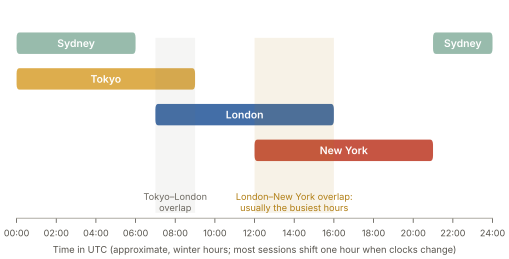
- Sydney (about 21:00–06:00 UTC) opens the week. It's usually quiet, apart from the Australian and New Zealand dollars.
- Tokyo (about 00:00–09:00 UTC) brings more activity in the yen, the Australian dollar, and the New Zealand dollar.
- London (about 07:00–16:00 UTC) is the busiest centre for forex in the world, handling well over a third of all trading. EUR/USD, GBP/USD, and the other European pairs wake up here.
- New York (about 12:00–21:00 UTC) brings US economic data and a lot of dollar trading.
The London–New York overlap, roughly 12:00–16:00 UTC, is usually the busiest few hours of the day, with the tightest spreads and the biggest moves in the major pairs. That's also when most of the important US data comes out.
Which hours suit you?
You don't have to trade every session. Most people can't, because they also have school, a job, or a life. It's better to choose one or two sessions that fit your day and learn how your pairs behave in them. A pair like EUR/USD can move very little during the Asian session and then come alive at the London open, because that's when the people who trade euros most are at their desks.
Here's what the London open (08:00 UTC in winter) looks like in different places:
| City | Usual offset from UTC (winter) | London open (08:00 UTC) |
|---|---|---|
| New York | UTC−5 | 03:00 |
| São Paulo | UTC−3 | 05:00 |
| London | UTC+0 | 08:00 |
| Lagos | UTC+1 | 09:00 |
| Kigali, Johannesburg | UTC+2 | 10:00 |
| Nairobi | UTC+3 | 11:00 |
| Dubai | UTC+4 | 12:00 |
| Mumbai | UTC+5:30 | 13:30 |
| Singapore, Manila | UTC+8 | 16:00 |
| Tokyo | UTC+9 | 17:00 |
Daylight saving makes this messier. The UK, Europe, the US, and Australia change their clocks on different dates, so for a week or two in March and in October or November, the gaps between sessions shift by an hour. When in doubt, check a session clock or your broker's server time.
Quiet days and weekends
The market closes at the weekend, but the world doesn't. If something big happens on a Saturday, prices can open on Monday at a very different level from where they closed on Friday. This is called a gap, and it can jump straight over your stop loss. Markets are also thin around holidays such as Christmas and New Year, when spreads widen and price can move in odd, jerky ways. Plenty of experienced traders simply don't trade then.
Open MetaTrader on your demo account and look at the time at the top of the Market Watch window. That's your broker's server time, which is often UTC+2 or UTC+3 so that each daily candle closes at 5 p.m. New York time. Work out the difference between server time, UTC, and your own time zone, and write it on a sticky note. You'll need it when you read the economic calendar in Chapter 25.
Key terms from this lesson
- Interbank market
- the network in which large banks trade currencies with each other.
- Hedging
- trading to reduce the risk of losses from price changes, as companies do with currencies they'll need later.
- Trading session
- the hours when a major financial centre is open and active.
- Overlap
- a period when two sessions are open at once.
- Gap
- a jump in price between one candle's close and the next one's open, often over a weekend.
- Server time
- the clock your broker's platform uses for charts and candles.
Learn this in a 5-minute interactive lesson
Real charts and practice questions. Free, no sign-up needed.
Related guides
Pajama Markets provides education, not financial advice. Trading forex, crypto and leveraged products carries a high risk of losing money. Practise on a demo account first.