Forex Trading · lesson 6 of 33
Leverage and Margin Explained
Learn this in a 5-minute interactive lesson
Real charts and practice questions. Free, no sign-up needed.
Trading with a deposit
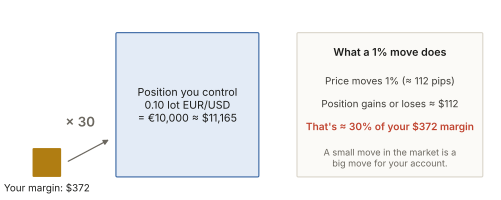
One standard lot of EUR/USD is €100,000. Most people don't have that lying around. Leverage lets you open a position much bigger than the money in your account by putting down a deposit, called margin, while the broker covers the rest.
Think of margin like the deposit when you rent a flat. You don't pay for the whole building; you hand over a deposit that sits there while you live in it. But if something goes wrong, the deposit is the first thing to go, and if the damage is bigger than the deposit, you've got a bigger problem.
Leverage is written as a ratio. 30:1 (or 1:30) means that for every $1 of margin you can control $30 of position. Put another way, the margin is 1/30 of the position, or about 3.33 percent.
How much margin do you need?
Margin = position value ÷ leverage, where position value = units × price, converted to your account currency.
Position value: 10,000 × 1.1165 = $11,165.
- At 30:1: 11,165 ÷ 30 = $372.17
- At 100:1: 11,165 ÷ 100 = $111.65
- At 500:1: 11,165 ÷ 500 = $22.33
Same trade, same profit or loss per pip ($1 a pip), very different deposit. That's the important bit: leverage changes how much margin is locked up, not how much each pip is worth.
The account numbers on your screen
Every platform shows the same handful of numbers. Here's what they mean, using Alex's demo account from Chapter 11, which has $1,000 in it and one 0.10 lot EUR/USD trade that's $12.80 in profit:
- Balance: the money in the account, not counting open trades. $1,000.00
- Equity: balance plus or minus floating profit and loss. 1,000 + 12.80 = $1,012.80
- Margin (used margin): the deposit locked up by open trades. $372.17
- Free margin: equity minus used margin. This is what's left to open new trades or absorb losses. 1,012.80 − 372.17 = $640.63
- Margin level: equity ÷ used margin × 100. 1,012.80 ÷ 372.17 × 100 = 272.13%
Margin call and stop-out
If your open trades lose money, your equity falls, and so does your margin level. Brokers set two danger lines:
- A margin call is a warning, often at a margin level of 100 percent, when your equity has fallen to the same amount as your used margin. You can't open new trades, and the platform will flash at you.
- A stop-out is when the broker starts closing your trades automatically, largest loss first, to stop your account going below zero. In the EU, the UK, and Australia, retail brokers have to do this when your margin level falls to 50 percent. Offshore brokers often set it lower, sometimes 20 percent or less.
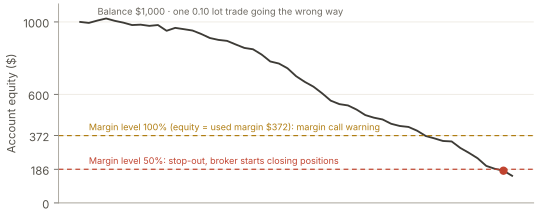
A stop-out is not a risk-management plan. It's what happens when there wasn't one. By the time it kicks in, you've usually lost most of the money in the account.
Leverage limits
Because so many beginners blew up their accounts with very high leverage, regulators in many countries cap it for retail traders:
| Where | Major currency pairs | Other pairs, gold, major indices |
|---|---|---|
| European Union, United Kingdom, Australia | 30:1 | 20:1 |
| United States | 50:1 | 20:1 |
| Many offshore brokers | 500:1, 1000:1, or more | Varies |
Regulated brokers in Europe, the UK, and Australia must also give retail clients negative balance protection, which means you can't lose more than the money you deposited. Check whether your broker offers it, wherever you are.
Is high leverage dangerous?
Partly. Here's the honest version. The money you can lose on a trade depends on your position size and your stop loss, not on the leverage itself. A 0.10 lot trade with a 25-pip stop risks $25, whether your leverage is 30:1 or 500:1. What high leverage does is let you open a much bigger position than you should, with very little money, without the platform stopping you. It removes the safety rail. And beginners, being human, tend to lean on the missing rail.
Alex and Kevin each have $1,000 on a 500:1 account.
Kevin opens 1.00 lot of EUR/USD. Margin needed: 111,650 ÷ 500 = $223.30, so the platform lets him. Each pip is $10. A move of 100 pips against him, which EUR/USD can manage in a day or two, costs $1,000. The account is gone. (In practice the stop-out closes him a bit before that, which is like being rescued from a sinking boat just as it touches the bottom.)
Alex opens 0.05 lot with a stop loss 40 pips away. Each pip is $0.50. If the stop is hit, Alex loses 40 × 0.50 = $20, which is 2 percent of the account. Annoying, survivable, and over by teatime.
Kevin chose the highest leverage his broker offered because "why would anyone pick less?" Leverage doesn't make your trades better. It just makes them bigger. A bad trade at a huge size is still a bad trade, only louder. Pick a modest leverage setting while you learn, and size every trade with the method in Chapter 28.
Key terms from this lesson
- Leverage
- the ratio between the size of a position and the margin needed to open it.
- Margin
- the deposit a broker locks up while a trade is open.
- Equity
- balance plus or minus floating profit and loss.
- Free margin
- equity minus used margin.
- Margin level
- equity divided by used margin, as a percentage.
- Margin call
- a broker's warning that equity has fallen close to the margin required.
- Stop-out
- the automatic closing of positions by the broker when margin level falls to a set level.
- Negative balance protection
- a rule or policy that stops a client's account going below zero.
Learn this in a 5-minute interactive lesson
Real charts and practice questions. Free, no sign-up needed.
Related guides
Pajama Markets provides education, not financial advice. Trading forex, crypto and leveraged products carries a high risk of losing money. Practise on a demo account first.