Forex Trading · lesson 7 of 33
The Cost of Trading: Spreads, Commissions, and Swaps Explained
Learn this in a 5-minute interactive lesson
Real charts and practice questions. Free, no sign-up needed.
The spread: paying to get in
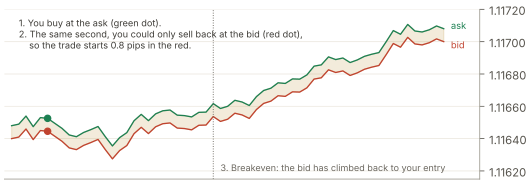
Every trade starts slightly in the red, because you buy at the ask and could only sell straight back at the bid. You have to make back the spread before you're in profit.
The cost of the spread in money is: spread in pips × pip value × lots.
EUR/USD spread: 0.8 pips. Trade size: 1.00 lot (pip value $10). Cost: 0.8 × $10 × 1 = $8.
On 0.10 lot, the same spread costs $0.80. Small, but it's charged on every trade, win or lose.
Commissions and account types
Brokers usually offer two kinds of account:
- A standard account has no commission, but the spread is wider, often around 1 to 1.5 pips on EUR/USD. The broker's fee is built into the spread.
- A raw-spread or ECN account has very tight spreads, often 0.0 to 0.3 pips, plus a fixed commission, often around $6 to $7 per standard lot for opening and closing combined (called a "round turn").
You trade 1 lot of EUR/USD.
Standard account: spread 1.1 pips, no commission. Cost: 1.1 × $10 = $11.00.
Raw account: spread 0.2 pips plus $7 commission. Cost: 0.2 × $10 + $7 = $9.00.
Here the raw account is $2 cheaper per lot. If you trade often, that adds up quickly. If you place two trades a month, it hardly matters, and it's more important to pick a well-regulated broker than to save a couple of dollars.
Swaps: the cost of staying overnight
If you keep a trade open past the daily rollover, which usually happens at 5 p.m. New York time (around 21:00 to 22:00 UTC), you'll be charged or paid a swap, also called overnight financing. It's based on the difference between the interest rates of the two currencies, plus a fee for the broker.
If you buy a currency with a higher interest rate against one with a lower rate, the swap might be positive, so you get paid a little each night. Usually, after the broker's fee, both directions end up negative or one is only slightly positive. Your platform's contract specification shows the current swap rates for long and short positions.
Most forex pairs charge three days of swap on Wednesday night. That's because forex trades normally settle two working days later, and a position held over Wednesday night settles across the weekend. Kevin once held a trade over a Wednesday, saw three swaps come out at once, and accused the broker of stealing. It was in the specification the whole time.
Some brokers offer swap-free accounts, often called Islamic accounts, for traders who can't pay or receive interest for religious reasons. They may charge a flat fee instead after a certain number of days.
Slippage and spread widening
Slippage happens when your order is filled at a different price from the one you clicked, because the price moved between your click and the broker's execution. It can work for you or against you, but in fast markets it usually works against you.
Spreads aren't fixed either. They often widen sharply:
- around the daily rollover, when banks in New York close their books and liquidity is thin;
- during big news releases, such as US jobs figures or interest-rate decisions (Chapter 25);
- when the market opens on Sunday night or Monday morning;
- on public holidays, when fewer banks are trading.
A spread of 0.8 pips can jump to 5 or 10 pips for a few minutes. If your stop loss is very close to the price, that alone can trigger it.
The other costs
Look out for deposit and withdrawal fees, currency conversion fees if your account currency differs from the money you deposit, and inactivity fees if you stop trading for a few months. None of these are huge on their own, but they're worth checking before you pick a broker.
A scalper places 20 trades a day of 1 lot each at a total cost of $9 a trade: 20 × $9 = $180 a day, or about $3,600 over a 20-day month. That's a lot of profit to make just to break even.
A swing trader places 6 trades a month at the same cost: 6 × $9 = $54 a month, plus some swaps.
The shorter your trades, the more costs eat into your results.
Key terms from this lesson
- Commission
- a fixed fee per trade, charged on raw-spread or ECN accounts.
- Round turn
- opening and closing a trade; commissions are often quoted per round turn.
- Rollover
- the daily moment, usually 5 p.m. New York time, when open positions are carried into the next day.
- Swap (overnight financing)
- interest charged or paid for holding a position past the rollover.
- Slippage
- the difference between the price you expected and the price you actually got.
- Spread widening
- a temporary increase in the spread, often during news or thin markets.
Learn this in a 5-minute interactive lesson
Real charts and practice questions. Free, no sign-up needed.
Related guides
Pajama Markets provides education, not financial advice. Trading forex, crypto and leveraged products carries a high risk of losing money. Practise on a demo account first.