Forex Trading · lesson 9 of 33
Brokers: Choosing One You Can Trust Explained
Learn this in a 5-minute interactive lesson
Real charts and practice questions. Free, no sign-up needed.
What a broker does
You can't walk into the interbank market and start trading with a few hundred dollars. A broker gives you access. It offers you prices, runs the platform, holds your money, executes your trades, and handles all the background settlement. In return, it earns money from spreads, commissions, and swaps.
Brokers handle your orders in one of two main ways, and plenty of brokers use a mix of both:
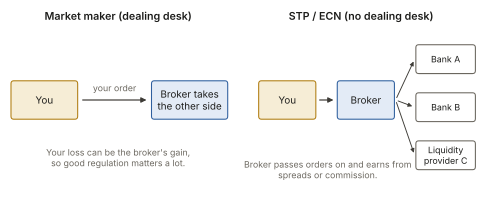
- A market maker, or dealing-desk broker, takes the other side of your trade. If you buy, it sells to you. It may then balance its overall position with banks, but in principle your loss can be its gain.
- An STP (straight-through processing) or ECN (electronic communication network) broker passes your order to banks and other big liquidity providers, and makes money from the spread or a commission.
Neither model is automatically good or bad. What matters most is whether the broker is well regulated, treats clients fairly, and pays out when you ask for your money.
Regulation comes first
A regulator is a government body that licenses brokers, sets rules for them, and can fine them or shut them down if they break the rules. Good regulation usually means your money is kept separate from the broker's own money (segregated funds), the broker has to have enough capital to survive, leverage is capped, marketing is controlled, and there's somewhere to complain if things go wrong.
| Country or region | Main regulator(s) |
|---|---|
| United Kingdom | Financial Conduct Authority (FCA) |
| European Union | National regulators under EU rules, e.g. CySEC (Cyprus), BaFin (Germany), AMF (France) |
| Australia | Australian Securities and Investments Commission (ASIC) |
| United States | Commodity Futures Trading Commission (CFTC) and National Futures Association (NFA) |
| Canada | Canadian Investment Regulatory Organization (CIRO) |
| Japan | Financial Services Agency (FSA) |
| Singapore | Monetary Authority of Singapore (MAS) |
| South Africa | Financial Sector Conduct Authority (FSCA) |
| Kenya | Capital Markets Authority (CMA) |
| United Arab Emirates | Dubai Financial Services Authority (DFSA) and the Securities and Commodities Authority (SCA) |
Many brokers also operate through companies registered in places with much lighter rules, such as Seychelles, Mauritius, Vanuatu, or St Vincent and the Grenadines. (The regulator in St Vincent has said publicly that it doesn't license or supervise forex brokers at all.) These offshore companies are often the ones offering leverage of 500:1 or more and big deposit bonuses. Lighter regulation doesn't automatically mean a broker is crooked, but it does mean you have much less protection if something goes wrong.
Also check which country's rules apply to you. Some countries restrict which brokers their residents can use. In the United States, for example, retail forex is only allowed through firms registered with the CFTC and the NFA, and there aren't many of them.
How to check a licence
- 1.Find the broker's legal company name and licence number. It's usually at the very bottom of the website, in tiny writing, where companies put things they hope you won't read.
- 2.Go to the regulator's own website, not a link from the broker, and search its public register for that name and number.
- 3.Check that the website address listed on the register matches the website you're on. Scammers often set up clone firms that copy a real broker's name, logo, and licence number but use a different website.
- 4.Check which company you'd actually be signing up with. A well-known brand might have a UK company, a Cyprus company, and an offshore company. If you're being offered 1000:1 leverage, you're almost certainly being signed up with the offshore one.
What else to compare
Once a broker passes the regulation check, compare:
- Costs: spreads on the pairs you'll trade, commissions, swaps, and any fees for deposits, withdrawals, or inactivity.
- Platforms: whether it offers MT5, MT4, TradingView, or its own app.
- Deposits and withdrawals: which methods work in your country, how long withdrawals take, and whether there are fees.
- Protection: segregated funds, negative balance protection, and any compensation scheme. In the UK, for example, the Financial Services Compensation Scheme can cover up to £85,000 if an investment firm fails. Many countries have nothing like it.
- Demo account: whether you can practise on the same platform first.
- Support: whether you can reach a human who actually knows the answer.
Be careful with "best broker" websites and online reviews. A lot of review sites earn a commission for every person they send to a broker, so the "best" broker can be whichever one pays the most.
Red flags
Walk away if you see any of these:
- promises of guaranteed or fixed returns, like "10% a week";
- someone offering to trade for you as an "account manager" and asking for your login details;
- first contact through Instagram, WhatsApp, Telegram, or a dating app;
- big bonuses that come with conditions you only discover when you try to withdraw;
- pressure to deposit more, especially to "unlock" a withdrawal or pay a "tax" first;
- no licence, or a licence you can't find on the regulator's register;
- withdrawals that keep getting delayed with new excuses.
Kevin found his first broker through an advert that offered 3000:1 leverage and a 100% deposit bonus. He deposited $300, received a "$300 bonus," and doubled the account in two days. When he tried to withdraw, he was told he had to trade 40 times the bonus amount first, and then that he needed to pay a "processing fee." He never saw the money again. If a broker's offer sounds like it was written by someone who desperately wants your deposit, it probably was.
It's true that a market-making broker can profit when clients lose, and that's exactly why regulation matters. But good brokers make most of their money from clients who keep trading for years, which means clients who don't blow up. A regulated broker that cheated clients on prices would risk its licence. Your bigger risks are an unregulated broker, and your own position sizing.
Key terms from this lesson
- Broker
- a firm that gives retail traders access to the market, offers prices, and executes trades.
- Market maker
- a broker that takes the other side of its clients' trades.
- STP / ECN broker
- a broker that passes client orders to banks and other liquidity providers.
- Regulator
- a government body that licenses and supervises financial firms.
- Segregated funds
- client money held separately from the broker's own money.
- Clone firm
- a fake firm that copies the name and details of a real, regulated firm.
Learn this in a 5-minute interactive lesson
Real charts and practice questions. Free, no sign-up needed.
Related guides
Pajama Markets provides education, not financial advice. Trading forex, crypto and leveraged products carries a high risk of losing money. Practise on a demo account first.