Forex Trading · lesson 4 of 33
Pips and Pipettes Explained
Learn this in a 5-minute interactive lesson
Real charts and practice questions. Free, no sign-up needed.
The smallest move that matters
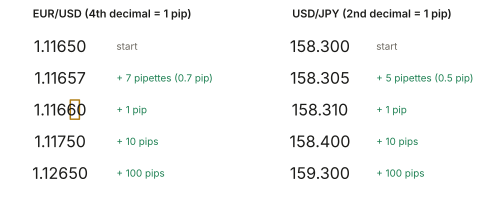
Currency prices move in tiny steps. Saying "the euro moved 0.0025 dollars" is clumsy, so traders use a unit called a pip. For most pairs, one pip is the fourth decimal place, or 0.0001. If EUR/USD moves from 1.1165 to 1.1166, it has moved one pip. If it moves from 1.1165 to 1.1265, it's moved 100 pips.
Pairs with the Japanese yen are different, because one yen is worth much less than one dollar or one euro. For JPY pairs, one pip is the second decimal place, or 0.01. If USD/JPY moves from 158.30 to 158.31, that's one pip.
Most brokers now quote prices with one extra digit, a tenth of a pip, called a pipette. That's the little superscript digit you saw on the quote in Chapter 2. So EUR/USD at 1.11657 is 1.1165 and seven-tenths of a pip.
Counting pips
To count the pips between two prices, subtract one from the other and divide by the pip size.
EUR/USD moves from 1.11648 to 1.12093. Difference: 1.12093 − 1.11648 = 0.00445. Pips: 0.00445 ÷ 0.0001 = 44.5 pips up.
USD/JPY moves from 158.30 to 157.42. Difference: 157.42 − 158.30 = −0.88. Pips: 0.88 ÷ 0.01 = 88 pips down.
A quick trick: for normal pairs, look at the last four decimal places and pretend they're a whole number. 1.1165 → 1.1203 is like 1165 → 1203, which is 38 pips. For yen pairs, do the same with the last two decimal places.
MetaTrader's "points"
Here's a trap that catches nearly everyone. MetaTrader measures things in points, and a point is the smallest price step the broker quotes. On a five-digit price like 1.11657, one point is 0.00001, which is a pipette, not a pip. So when Market Watch shows a spread of 8, it means 8 points, which is 0.8 pips. When an automated trading tool asks for a stop loss of "200," it usually means 200 points, which is 20 pips. Always check which unit you're looking at before you type a number in. Getting this wrong by a factor of ten is how people accidentally set a stop loss so tight that it gets hit by a sneeze.
Gold and other non-currency markets
For gold, silver, oil, and indices, the word "pip" gets used loosely and different brokers mean different things by it. With gold quoted at something like 4,068.12, some people call $0.01 a point and $0.10 a pip, others call $1.00 a pip. Don't argue about it. Check your broker's contract specification (Chapter 5 shows you where), and think in terms of price distance and money rather than pips.
Why traders bother with pips
Pips let you compare price moves without worrying about trade size. "EUR/USD moved 60 pips today" means the same thing to a trader with $100 and to a bank with $100 million. On a normal day, EUR/USD often moves somewhere between 50 and 100 pips from its low to its high, although quiet days can be much smaller and big news days much bigger.
Key terms from this lesson
- Pip
- the standard unit of price movement: 0.0001 for most pairs and 0.01 for JPY pairs.
- Pipette
- one tenth of a pip; the fifth decimal place for most pairs and the third for JPY pairs.
- Point
- in MetaTrader, the smallest price step a symbol is quoted in; on five-digit pricing it equals a pipette.
Learn this in a 5-minute interactive lesson
Real charts and practice questions. Free, no sign-up needed.
Related guides
Pajama Markets provides education, not financial advice. Trading forex, crypto and leveraged products carries a high risk of losing money. Practise on a demo account first.