Forex Trading · lesson 3 of 33
Buying, Selling, and Going Short Explained
Learn this in a 5-minute interactive lesson
Real charts and practice questions. Free, no sign-up needed.
Buying a pair
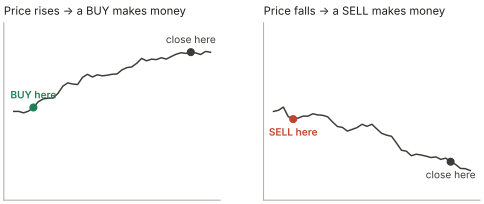
When you buy EUR/USD, you're buying euros and paying for them with dollars. You make money if the euro rises against the dollar, because the price of EUR/USD goes up. Traders call this going long, and a trader who expects prices to rise is bullish. (A bull attacks by thrusting its horns upwards. Remember that and you'll never mix the words up.)
Selling a pair
When you sell EUR/USD, you're selling euros and receiving dollars. You make money if the euro falls against the dollar, because the price goes down. This is going short, and a trader who expects prices to fall is bearish. (A bear swipes downwards with its paws. The animal kingdom is weirdly useful in finance.)
How can you sell something you don't own?
This bit confuses everyone at first, so here's the easiest way to picture it. Say your cousin lends you a pair of limited-edition trainers that are selling for $200. You sell them straight away for $200. A month later, everyone's moved on to a new trend and the same trainers sell for $150. You buy a pair for $150, give them back to your cousin, and you're $50 better off. You sold first and bought later, and you made money because the price fell. (Your cousin may never lend you anything again, but that's a separate problem.)
In forex, it's even simpler, because every trade is already a swap of two currencies. Selling EUR/USD is the same thing as buying dollars with euros. The broker handles everything in the background, so selling is just as easy as buying: you press Sell instead of Buy.
Working out profit and loss
For any trade, the profit or loss in the quote currency is:
- Buy: (closing price − opening price) × number of units
- Sell: (opening price − closing price) × number of units
Alex buys 10,000 units of EUR/USD at 1.1150 and closes at 1.1200. Profit = (1.1200 − 1.1150) × 10,000 = 0.0050 × 10,000 = $50.
Kevin sells 10,000 units of GBP/USD at 1.3380 because "it looked tired." The price rises to 1.3450 and he finally closes it. Result = (1.3380 − 1.3450) × 10,000 = −0.0070 × 10,000 = −$70.
The price was never tired. Kevin was.
Open, floating, closed
While a trade is open, the profit or loss you see on screen is floating (or unrealised) profit or loss. It changes with every tick of the price and isn't really yours yet. When you close the trade, it becomes realised profit or loss and is added to or taken from your account balance. A lot of beginners get excited about floating profit, don't close, and watch it turn into a floating loss. Floating profit is a bit like a cake in the oven: it isn't dessert until it's out.
To close a trade, you do the opposite of what you opened with. If you bought, closing means selling the same amount, and if you sold, closing means buying it back. On every platform there's a simple close button, so you don't need to do this by hand.
Key terms from this lesson
- Long
- a position that profits when the price rises; opened by buying.
- Short
- a position that profits when the price falls; opened by selling.
- Bullish / bearish
- expecting prices to rise / fall.
- Floating (unrealised) profit or loss
- the profit or loss on a trade that's still open.
- Realised profit or loss
- the profit or loss locked in when a trade is closed.
Learn this in a 5-minute interactive lesson
Real charts and practice questions. Free, no sign-up needed.
Related guides
Pajama Markets provides education, not financial advice. Trading forex, crypto and leveraged products carries a high risk of losing money. Practise on a demo account first.