Forex Trading · lesson 2 of 33
Currency Pairs and Quotes Explained
Learn this in a 5-minute interactive lesson
Real charts and practice questions. Free, no sign-up needed.
Three-letter names
Every currency has a three-letter code. Usually the first two letters are the country and the third is the currency's name: USD is the US dollar, GBP is Great Britain's pound, JPY is the Japanese yen, CAD is the Canadian dollar. A few break the pattern, like EUR for the euro, which belongs to lots of countries at once and refused to pick one.
| Code | Currency | Code | Currency |
|---|---|---|---|
| USD | US dollar | CHF | Swiss franc |
| EUR | Euro | AUD | Australian dollar |
| JPY | Japanese yen | CAD | Canadian dollar |
| GBP | British pound | NZD | New Zealand dollar |
The pair: base and quote
Currencies are always priced in pairs, because you can only say what a currency is worth by comparing it with another one. In EUR/USD = 1.1165:
- EUR is the base currency. It's the thing being priced. There's always exactly one unit of it.
- USD is the quote currency. It's what the price is written in.
- 1.1165 means one euro costs 1.1165 US dollars.
If you can read "1 coffee = $5," you can read "1 euro = $1.1165." The euro is the coffee.
You can flip a pair. If one euro costs 1.1165 dollars, one dollar costs 1 ÷ 1.1165 = 0.8957 euros. But the market has conventions about which way round to write each pair, so you'll almost always see EUR/USD, not USD/EUR. The usual pecking order puts EUR first, then GBP, AUD, NZD, USD, CAD, CHF, and JPY. Nobody voted on this. It's just how it's done, a bit like how everyone says "salt and pepper" and never "pepper and salt."
Bid, ask, and spread
On a trading platform, every pair shows two prices, not one.
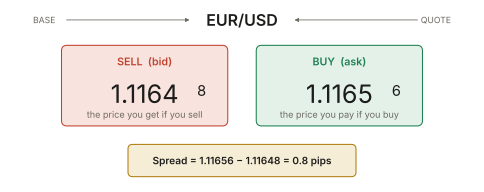
- The bid is the price the broker will pay you if you sell. It's always the lower one.
- The ask (sometimes called the offer) is the price you pay if you buy. It's always the higher one.
- The spread is the difference between them, and it's the main way many brokers get paid.
Think of a currency exchange booth at an airport. It buys your dollars cheap and sells you dollars expensive, and the gap between those two prices pays for the booth, the staff, and the slightly smug sign that says "0% commission!" A broker's spread works the same way, just much, much smaller.
Majors, minors, and exotics
Pairs fall into three groups:
Majors all include the US dollar and are the most traded currencies in the world. They usually have the tightest spreads, which makes them the cheapest to trade and the best place for beginners to start.
| Pair | Nickname | Illustrative price |
|---|---|---|
| EUR/USD | "Fiber" | 1.1165 |
| USD/JPY | "Gopher" (rarely used) | 158.30 |
| GBP/USD | "Cable" | 1.3384 |
| USD/CHF | "Swissie" | 0.8189 |
| AUD/USD | "Aussie" | 0.6871 |
| USD/CAD | "Loonie" | 1.4066 |
| NZD/USD | "Kiwi" | 0.5730 |
GBP/USD is called "cable" because in the 1800s the exchange rate between London and New York was sent along a telegraph cable under the Atlantic. The loonie gets its name from the bird on Canada's one-dollar coin. Traders love a nickname.
Minors, also called crosses, pair two major currencies without the US dollar, such as EUR/GBP, EUR/JPY, GBP/JPY, and AUD/JPY. They're still busy, but their spreads are a bit wider.
Exotics pair a major currency with the currency of a smaller or emerging economy, such as USD/MXN (Mexican peso), USD/TRY (Turkish lira), or USD/SGD (Singapore dollar). They can move a lot, their spreads are wide, and they can jump violently on local news. They're not where you want to learn.
Your broker will also offer things that aren't currencies at all, like gold (XAU/USD), silver, oil, and stock indices. They sit in the same platform and work in a similar way, but they have their own contract sizes and quirks. Stick to major pairs while you learn.
Alex has $500 and wants to know how many euros that buys at an ask price of 1.1165: 500 ÷ 1.1165 = €447.83.
Alex then sees USD/JPY at 158.30. What's ¥10,000 worth in dollars? 10,000 ÷ 158.30 = $63.17.
Notice that you divide when you're converting quote currency into base currency, and multiply when you go from base to quote. If that ever feels confusing, go back to the coffee: if one coffee is $5, then $20 buys 20 ÷ 5 = 4 coffees.
The size of the number tells you nothing about strength. It only tells you how many units of one currency it takes to buy one unit of another, and that depends mostly on history. What matters to a trader is whether the price is going up or down, not how big it is.
Key terms from this lesson
- Currency pair
- two currencies quoted against each other, such as EUR/USD.
- Base currency
- the first currency in a pair; the one being priced.
- Quote currency
- the second currency in a pair; the one the price is written in.
- Bid
- the price at which you can sell.
- Ask
- the price at which you can buy; also called the offer.
- Spread
- the difference between the bid and the ask.
- Major pair
- a pair that includes the US dollar and one of the other most-traded currencies.
- Cross (minor) pair
- a pair of major currencies that doesn't include the US dollar.
- Exotic pair
- a pair that includes the currency of a smaller or emerging economy.
Learn this in a 5-minute interactive lesson
Real charts and practice questions. Free, no sign-up needed.
Related guides
Pajama Markets provides education, not financial advice. Trading forex, crypto and leveraged products carries a high risk of losing money. Practise on a demo account first.