Crypto Trading · lesson 6 of 29
What Moves Crypto Prices
Learn this in a 5-minute interactive lesson
Real charts and practice questions. Free, no sign-up needed.
Supply, demand, and a lot of emotion
Like any price, a coin's price moves when buyers and sellers disagree about what it's worth. But crypto has a few extra features that make it move faster and further than most markets: it trades 24 hours a day, every day; it's driven heavily by sentiment and social media; and a lot of traders use high leverage. Here are the forces that matter most.
Bitcoin leads, everything else follows
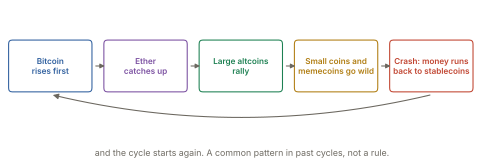
Bitcoin is the biggest crypto-asset by far, and most altcoins move in the same direction as bitcoin most of the time, just more violently. If bitcoin falls 10 percent in a day, it's common for smaller coins to fall 15 to 30 percent. When the leader trips, the people tied to it on the rope go over the edge too.
Bitcoin dominance is bitcoin's share of the total crypto market cap:
dominance = bitcoin's market cap ÷ total crypto market cap
If bitcoin is worth $1.6 trillion and the whole market is $2.7 trillion, dominance is 1.6 ÷ 2.7 ≈ 59 percent. Over the last decade it's swung between roughly 40 and 70 percent. Rising dominance usually means money is flowing into bitcoin or out of altcoins; falling dominance often means traders are taking bigger bets on altcoins.
Interest rates and the dollar
Crypto is very sensitive to the cost of money. When interest rates are low and money is easy to borrow, investors tend to buy riskier assets, crypto included. When rates rise quickly, risky assets usually suffer. In 2022, as the US Federal Reserve raised interest rates at the fastest pace in decades, bitcoin fell by more than 75 percent from its peak. Crypto likes to think of itself as separate from traditional finance, but it reacts to the Fed like everyone else.
ETFs and big buyers
Since 2024, spot bitcoin and ether ETFs have let investors buy crypto through ordinary brokerage accounts. On some days, billions of dollars flow into or out of these funds, and traders watch the daily flow figures closely. Large companies buying bitcoin for their treasuries have also moved prices, in both directions.
Leverage and liquidations
Many crypto traders use futures with high leverage (Chapter 17). When prices move sharply, leveraged positions get liquidated, which means they're force-closed, and those forced sales or purchases push prices further in the same direction. On 10 October 2025, a sudden sell-off triggered roughly $19 billion of liquidations in about a day, the largest on record. Many people who were "right in the long run" didn't survive the afternoon.
News, hacks, and failures
Crypto reacts sharply to news:
- Hacks: in October 2026, Binance, the world's largest exchange, lost an estimated $6.3 billion to hackers linked to North Korea, the biggest crypto theft ever recorded. Binance said it would cover customers' losses itself, but markets were shaken for days.
- Collapses: in November 2022 the exchange FTX collapsed after it emerged that customer money had been misused. Prices across the market crashed, and its founder was later sentenced to 25 years in prison.
- Regulation: new laws, court cases, and government statements can move prices in minutes.
Token unlocks and supply
When large amounts of a token's locked supply are released (Chapter 21), early investors and team members often sell some, which can push the price down. Traders keep a calendar of big unlocks, just as forex traders watch the economic calendar.
Narratives and social media
Crypto runs on stories. "AI tokens," "real-world assets," "the next Solana": when a narrative catches on, money pours into anything connected to it, sometimes before anyone has checked whether the projects actually work. Social-media influencers can move small coins enormously, which is also how a lot of people get used as someone else's exit (Chapter 27).
Weekends and thin markets
Crypto never closes, but fewer big traders are active at weekends and during holidays. With fewer orders in the market, prices can move sharply on relatively small trades, and spreads widen. A lot of dramatic Sunday-night moves are just a thin market and a few large orders.
Key terms from this lesson
- Bitcoin dominance
- bitcoin's share of the total crypto market capitalisation.
- Liquidation
- the forced closing of a leveraged position when losses use up its margin.
- Narrative
- a popular story or theme that drives money into a group of coins.
- Token unlock
- the scheduled release of previously locked tokens.
- Risk asset
- an investment whose price tends to rise when investors feel confident and fall when they're scared.
Learn this in a 5-minute interactive lesson
Real charts and practice questions. Free, no sign-up needed.
Related guides
Pajama Markets provides education, not financial advice. Trading forex, crypto and leveraged products carries a high risk of losing money. Practise on a demo account first.