Crypto Trading · lesson 7 of 29
Exchanges: Centralised and Decentralised Explained
Learn this in a 5-minute interactive lesson
Real charts and practice questions. Free, no sign-up needed.
Two kinds of exchange
You buy, sell, and trade crypto on an exchange. There are two very different kinds.
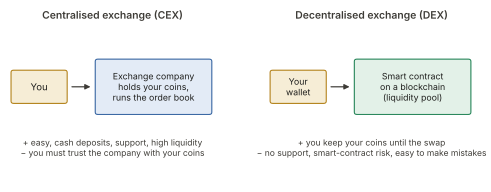
A centralised exchange (CEX) is a company, like a broker. You open an account, verify your identity, deposit money, and trade on its website or app. The exchange holds your coins for you and matches buyers with sellers. Well-known examples include Coinbase, Kraken, Binance, OKX, and Bybit, plus many regional exchanges. Centralised exchanges are easy to use, accept bank deposits, have customer support, and usually have plenty of buyers and sellers. The catch is that you have to trust the company with your money.
A decentralised exchange (DEX) is a set of smart contracts on a blockchain, such as Uniswap on Ethereum or various DEXs on Solana. You connect your own wallet and swap tokens directly, without an account. Nobody holds your coins for you, which is great until you make a mistake, because there's also nobody to help you. Part IV covers DEXs properly. For now, start on a centralised exchange.
Not your keys, not your coins
When your coins sit on a centralised exchange, you don't really hold crypto. You hold the exchange's promise to give you crypto when you ask for it. That's fine as long as the exchange is honest, solvent, and not hacked. History shows that's not always the case:
- Mt. Gox, once the world's biggest bitcoin exchange, collapsed in 2014 after losing around 850,000 bitcoin to theft and mismanagement. Customers waited about ten years to get some of their money back.
- FTX, one of the largest exchanges in the world, collapsed in November 2022 when it turned out customer deposits had been secretly used by a related trading firm. Withdrawals were frozen overnight. Its founder, Sam Bankman-Fried, was convicted of fraud and sentenced to 25 years in prison.
- Binance, the largest exchange, lost an estimated $6.3 billion from its hot wallets to hackers in October 2026. It said it would cover customers' losses from its own funds, and withdrawals were paused for a couple of days while it restored them.
That's why crypto people say "not your keys, not your coins." It doesn't mean you can never use an exchange. It means you shouldn't keep more there than you need for trading, and you should know how to move your coins to your own wallet (Chapter 9).
Choosing a centralised exchange
- 1.Is it licensed where you live? In the EU, exchanges need a licence under the MiCA rules. In the UK, they must be registered with the Financial Conduct Authority. Other examples include the FSA in Japan, the MAS in Singapore, VARA in Dubai, and the FSCA in South Africa. Check the regulator's own website, not the exchange's claims.
- 2.Track record: how long has it operated, has it been hacked, and how did it treat customers when things went wrong?
- 3.Proof of reserves: does it publish regular evidence that it holds customers' coins one-for-one? This is useful but not perfect, because it doesn't always show the exchange's debts.
- 4.Withdrawals: read recent reviews about how quickly people actually get their money out. A slow withdrawal is a warning sign.
- 5.Fees: trading fees, deposit and withdrawal fees, and the spread on "instant buy" buttons (Chapter 8).
- 6.Security features: authenticator-app two-factor login, withdrawal whitelists, and anti-phishing codes (Chapter 11).
- 7.Deposit methods that work in your country, and in your currency.
Some exchanges don't accept customers from certain countries, and some countries restrict crypto trading altogether. Using a VPN to get round an exchange's country rules can get your account frozen, often at the worst moment, so don't.
FTX was one of the biggest and most famous exchanges in the world, had celebrity adverts and sports-stadium sponsorship deals, and collapsed in about a week. Size and marketing aren't the same as safety. Spread your risk, and keep long-term holdings in your own wallet.
Key terms from this lesson
- Exchange
- a platform for buying, selling, and trading crypto.
- Centralised exchange (CEX)
- a company that holds customers' crypto and matches their orders.
- Decentralised exchange (DEX)
- smart contracts that let users trade directly from their own wallets.
- Proof of reserves
- evidence published by an exchange that it holds customers' assets.
- MiCA
- the European Union's rules for crypto-assets and the firms that offer them.
- "Not your keys, not your coins"
- the idea that if someone else holds the private keys, you're relying on their promise.
Learn this in a 5-minute interactive lesson
Real charts and practice questions. Free, no sign-up needed.
Related guides
Pajama Markets provides education, not financial advice. Trading forex, crypto and leveraged products carries a high risk of losing money. Practise on a demo account first.