Crypto Trading · lesson 5 of 29
Altcoins, Stablecoins, and Tokens Explained
Learn this in a 5-minute interactive lesson
Real charts and practice questions. Free, no sign-up needed.
Everything that isn't bitcoin
Altcoin just means "alternative coin": anything that isn't bitcoin. There are tens of thousands of them. Some are serious projects with real users. Many are experiments. A lot are abandoned, and some were scams from the start. Here's a rough map:
| Type | What it is | Examples |
|---|---|---|
| Layer 1 coins | Coins of other base blockchains | ETH, SOL, ADA |
| Layer 2 tokens | Tokens of Ethereum's scaling networks | ARB, OP |
| DeFi tokens | Tokens of lending, trading, and other DeFi apps | UNI, AAVE |
| Exchange tokens | Tokens issued by exchanges | BNB |
| Stablecoins | Tokens designed to stay at $1 | USDT, USDC |
| Memecoins | Tokens based on jokes, animals, and internet culture | DOGE, SHIB, and thousands more |
Price means nothing on its own. Market cap matters.
The price of one coin depends on how many coins there are. To compare projects, traders use market capitalisation:
market cap = price × circulating supply
The circulating supply is the number of coins that exist and can be traded right now. Many tokens also have coins that are locked up, to be released later to the team, early investors, or the project's treasury. If you count those too, you get the fully diluted value (FDV):
FDV = price × total (or maximum) supply
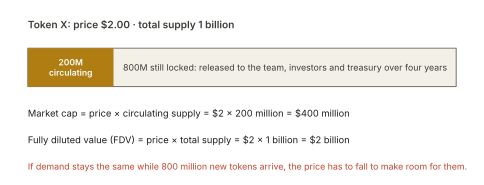
Bitcoin at $80,000 with about 20.1 million coins has a market cap of about 80,000 × 20,100,000 = $1.6 trillion.
Kevin buys a memecoin at $0.00002 because it "only needs to reach $1 to make me a millionaire." The coin has 500 trillion tokens. At $1 each, its market cap would be $500 trillion, which is several times the size of the entire world economy. It's not going to happen. The price looked tiny only because the supply was enormous.
Stablecoins: crypto that tries to sit still
A stablecoin is a token designed to stay at a steady value, usually one US dollar. Traders use stablecoins as their "cash" on exchanges, and many people use them to hold or send dollars. In November 2026, stablecoins were worth around $295 billion in total. The two biggest are Tether (USDT), at about $177 billion, and USD Coin (USDC), at about $70 billion.
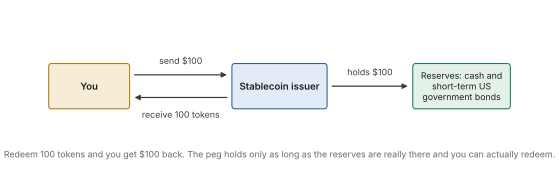
There are three main kinds:
- Fiat-backed stablecoins, such as USDT and USDC, are backed by reserves of cash and short-term government bonds held by the company that issues them. The main risk is the issuer: are the reserves really there, are they safe, and can you redeem? In March 2023, USDC briefly fell to about 87 cents when part of its reserves was stuck in a failed US bank, Silicon Valley Bank. It recovered within days once the money was released.
- Crypto-backed stablecoins are backed by other crypto, held in smart contracts, with more collateral than the stablecoins issued, so a fall in the collateral's price doesn't immediately break the peg. The risk is a crash big and fast enough to overwhelm that buffer, or a bug in the code.
- Algorithmic stablecoins try to hold the peg using code and a linked token instead of real reserves. The most famous one, TerraUSD, collapsed in May 2022, wiping out about $40 billion of value in a week. It was stable right up until the moment it wasn't.
Regulators have started setting rules. The United States passed the GENIUS Act in July 2025, requiring regulated dollar stablecoins to be fully backed by high-quality reserves, and the European Union's MiCA rules cover stablecoins issued or offered in Europe.
Kevin moved his savings into a stablecoin he'd never heard of because it paid "20% a year, guaranteed." He thought a stablecoin was a stablecoin. It turned out to be an algorithmic one run by an anonymous team, and it lost its peg in an afternoon. Ask the question you'd ask of any money: who issues it, what backs it, and can you get your dollar back?
Key terms from this lesson
- Altcoin
- any cryptocurrency other than bitcoin.
- Market capitalisation (market cap)
- price multiplied by circulating supply.
- Circulating supply
- the number of coins currently available to trade.
- Fully diluted value (FDV)
- price multiplied by total supply, including locked tokens.
- Stablecoin
- a token designed to hold a stable value, usually $1.
- Peg
- the fixed value a stablecoin aims to hold.
- Depeg
- when a stablecoin's price moves away from its peg.
- Memecoin
- a token based on a joke, animal, or internet trend, usually with no use beyond trading.
Learn this in a 5-minute interactive lesson
Real charts and practice questions. Free, no sign-up needed.
Related guides
Pajama Markets provides education, not financial advice. Trading forex, crypto and leveraged products carries a high risk of losing money. Practise on a demo account first.