Crypto Trading · lesson 4 of 29
Ethereum, Smart Contracts, and Other Blockchains Explained
Learn this in a 5-minute interactive lesson
Real charts and practice questions. Free, no sign-up needed.
A computer everyone shares
Bitcoin is mainly built to do one thing: move bitcoin. In 2015, a group led by a 21-year-old programmer called Vitalik Buterin launched Ethereum, a blockchain that can run small programs called smart contracts. If Bitcoin is a calculator, Ethereum is a smartphone: you can build apps on it.
A smart contract is code on a blockchain that does something automatically when certain conditions are met. The classic comparison is a vending machine: put in the right money, press the button, and the machine gives you a drink. No shop assistant needed, and the machine can't change its mind. On Ethereum, smart contracts run token swaps, loans, stablecoins, games, and almost everything else in Part IV.
Gas: paying for computer time
Every action on Ethereum, from sending ETH to swapping tokens, uses some computing work, measured in gas. You pay for gas in ETH, Ethereum's coin. The price of gas goes up when lots of people are using the network at once, a bit like taxi surge pricing on a Friday night.
Gas prices are quoted in gwei, where 1 gwei is a billionth of an ETH (0.000000001 ETH).
A simple ETH transfer uses 21,000 gas. The gas price is 2 gwei, and ETH is $2,400.
Fee in gwei: 21,000 × 2 = 42,000 gwei. Fee in ETH: 42,000 × 0.000000001 = 0.000042 ETH. Fee in dollars: 0.000042 × $2,400 = about $0.10.
A complicated DeFi action might use 200,000 gas or more, and in a busy moment the gas price might be 30 gwei. Then the fee is 200,000 × 30 × 0.000000001 × 2,400 = $14.40. Same network, very different bill. Your wallet shows the estimated fee before you confirm, so always look at it.
Ethereum's big changes
- In August 2021, an upgrade started burning part of every transaction fee, permanently destroying some ETH. When the network is very busy, more ETH can be burned than is created.
- In September 2022, "the Merge" switched Ethereum from proof of work to proof of stake, cutting its energy use by more than 99.9 percent overnight. Miners were replaced by validators.
- In July 2024, US spot ether ETFs started trading.
Unlike bitcoin, ETH has no fixed maximum supply. Its supply depends on how much new ETH is paid to validators and how much is burned.
Layer 2s: express lanes
Ethereum can only fit so many transactions in each block, so it can get slow and expensive when it's busy. Layer 2 networks (L2s) are separate networks that process transactions quickly and cheaply, then post a compressed summary back to Ethereum, which acts as the final judge.
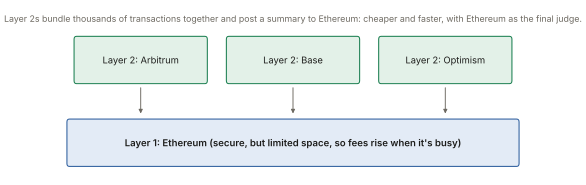
Well-known examples include Arbitrum, Optimism, and Base. Fees on L2s are often a few cents or less. The catch for beginners is that ETH on Arbitrum and ETH on Ethereum are on different networks, which matters a lot when you send coins (Chapter 10).
Other blockchains
There are dozens of other Layer 1 blockchains, each making different trade-offs between being secure, decentralised, and fast:
| Blockchain | Coin | Known for |
|---|---|---|
| Solana | SOL | Very fast and cheap; popular for trading and memecoins; has had outages in the past |
| BNB Chain | BNB | Linked to the Binance exchange; cheap; many copies of Ethereum apps |
| Tron | TRX | Widely used for sending USDT cheaply, especially in emerging markets |
| Avalanche, Cardano, and others | AVAX, ADA | Various designs; smaller ecosystems |
People sometimes call this the "blockchain trilemma": it's very hard to be secure, decentralised, and fast all at once, so each chain picks two and compromises on the third. It's a bit like a restaurant promising food that's cheap, fast, and good. You can usually have two.
Key terms from this lesson
- Ethereum
- a blockchain that runs smart contracts; its coin is ether (ETH).
- Smart contract
- code on a blockchain that runs automatically when conditions are met.
- Gas
- the unit measuring the computing work of an Ethereum transaction.
- Gwei
- one billionth of an ETH, used to price gas.
- Burn
- permanently destroying tokens.
- Layer 1
- a base blockchain, such as Bitcoin, Ethereum, or Solana.
- Layer 2
- a network that processes transactions and settles them on a Layer 1.
Learn this in a 5-minute interactive lesson
Real charts and practice questions. Free, no sign-up needed.
Related guides
Pajama Markets provides education, not financial advice. Trading forex, crypto and leveraged products carries a high risk of losing money. Practise on a demo account first.