Crypto Trading · lesson 10 of 29
Sending and Receiving Crypto Explained
Learn this in a 5-minute interactive lesson
Real charts and practice questions. Free, no sign-up needed.
The one-way door
Crypto transactions can't be reversed. There's no "undo," no chargeback, and no bank to call. If you send coins to the wrong address or the wrong network, they're usually gone. That sounds scary, and it should, a bit. But a simple routine makes it very unlikely to happen to you.
Same coin, different roads
The same coin can often travel on several networks. USDT, for example, exists on Ethereum, Tron, Arbitrum, Solana, BNB Smart Chain, and others. They're like different roads to the same city, except that the destination must have a door on the road you choose.
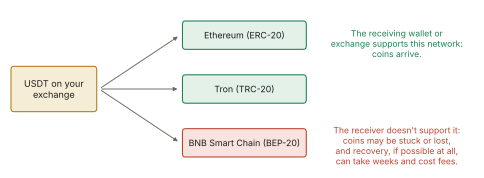
If you send USDT on the Tron network to an address that only supports Ethereum, the coins may be lost, or stuck until the receiving exchange agrees to recover them, which can take weeks, cost a fee, or never happen.
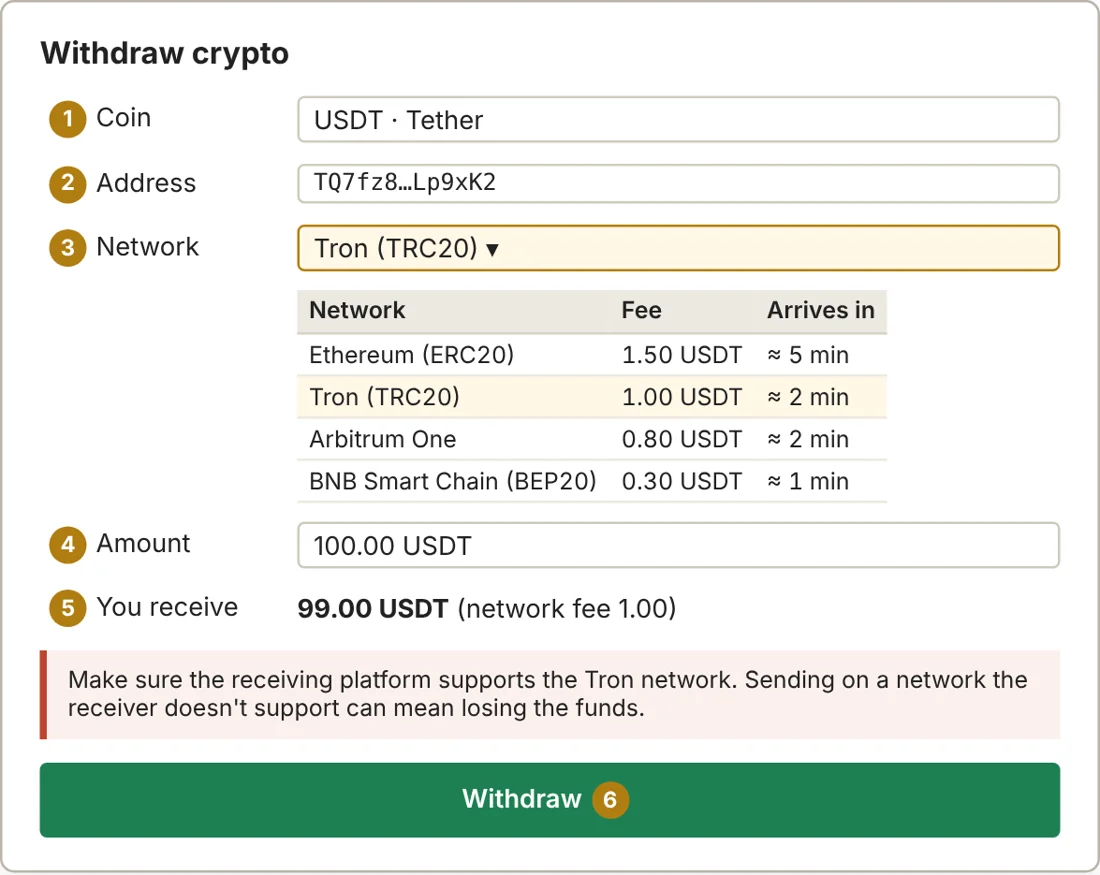
The safe-sending routine
- 1.On the receiving side, open the deposit page and choose the coin and the network. Copy the deposit address and any memo or tag.
- 2.On the sending side, choose the same coin and the same network. If that network isn't offered on both sides, stop and pick one that is.
- 3.Paste the address. Never type it by hand. Then check that the first and last five or six characters match exactly.
- 4.If the receiver gave you a memo or tag (common for XRP, XLM, and some exchange deposits), enter it. Without it, the exchange can't tell which account the coins belong to.
- 5.Send a small test amount first. Wait for it to arrive.
- 6.Once the test has arrived, send the rest.
- 7.Copy the transaction ID (TxID) and look it up on a block explorer to watch the confirmations.
Alex wants to send 100 USDT from an exchange to a friend's wallet. The exchange shows these fees (they change often):
- Ethereum (ERC20): 1.50 USDT, so the friend receives 98.50.
- Tron (TRC20): 1.00 USDT, so 99.00 arrives.
- Arbitrum One: 0.80 USDT, so 99.20 arrives.
The cheapest network is only the right one if the friend's wallet supports it. Saving 70 cents isn't worth losing 100 dollars.
You need gas on the destination network
To move tokens out of a self-custody wallet, you pay a network fee in that network's own coin. If you send USDC to your wallet on Arbitrum, you'll need a little ETH on Arbitrum to move it later. If you receive USDT on Tron, you'll need some TRX. Beginners often get "stuck" with tokens they can't move because they don't hold the gas coin. Keep a few dollars of the right gas coin on any network you use.
Address poisoning
Address poisoning is a sneaky scam. A scammer sends a tiny, worthless transaction to your wallet from an address that looks almost exactly like one you use often, matching the first and last few characters. Later, when you copy an address from your transaction history to send money, you copy theirs by mistake. Always copy addresses from the original source, such as your exchange's deposit page or your own saved address book, never from your transaction history. And for large amounts, check more than just the first and last characters.
Kevin withdrew $600 of USDT from one exchange to another and picked the cheapest network because "the fee was lower." The receiving exchange didn't support that network. After three weeks of support tickets, they recovered it for a $100 fee. He was lucky. Often there's no recovery at all.
Withdraw $5 to $10 of a stablecoin from your exchange to your own phone wallet, using a cheap network that both support. Look up the TxID on a block explorer. Then send it back to your exchange deposit address, including any memo. Write down every step and how long each took. Now you know the routine before you ever move real money.
Key terms from this lesson
- Network
- the blockchain a coin or token is sent on.
- Deposit address
- the address an exchange gives you to receive a specific coin on a specific network.
- Memo / tag
- an extra code some networks and exchanges need to identify your account.
- Transaction ID (TxID)
- the unique code of a blockchain transaction, used to look it up.
- Gas coin
- the coin used to pay network fees on a blockchain, such as ETH or TRX.
- Address poisoning
- a scam that plants a look-alike address in your history.
Learn this in a 5-minute interactive lesson
Real charts and practice questions. Free, no sign-up needed.
Related guides
Pajama Markets provides education, not financial advice. Trading forex, crypto and leveraged products carries a high risk of losing money. Practise on a demo account first.