Crypto Trading · lesson 3 of 29
Bitcoin Explained
Learn this in a 5-minute interactive lesson
Real charts and practice questions. Free, no sign-up needed.
Only 21 million, ever
Bitcoin's rules say there will never be more than 21 million bitcoin. New bitcoin are created only as the reward for adding blocks, and that reward gets cut in half roughly every four years, in an event called the halving.
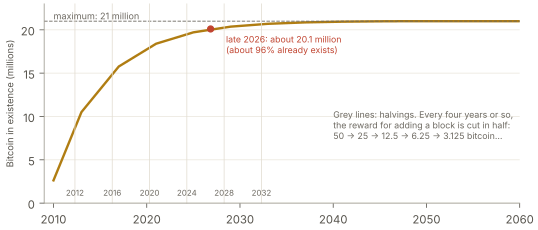
The reward started at 50 bitcoin per block in 2009. It dropped to 25 in 2012, 12.5 in 2016, 6.25 in 2020, and 3.125 in April 2024. The next halving is expected around 2028. About 20.1 million bitcoin exist by late 2026, so roughly 96 percent of all the bitcoin there will ever be has already been created. The rest will trickle out more and more slowly until about the year 2140, by which point we'll presumably be trading it from Mars.
Compare that with normal money, where central banks can create more whenever they decide to. This fixed, predictable supply is the main reason people call bitcoin "digital gold." (If you've done Money Foundations, you'll remember why scarcity matters for anything used as a store of value.)
You don't need a whole one
One bitcoin is divided into 100 million smaller units called satoshis, or sats, after Bitcoin's creator. You can buy a few dollars' worth.
Bitcoin is at $80,000. Alex wants to buy $20 worth.
$20 ÷ $80,000 = 0.00025 BTC.
In sats: 0.00025 × 100,000,000 = 25,000 sats.
If bitcoin then rises 10% to $88,000, Alex's 25,000 sats are worth 0.00025 × 88,000 = $22. If it falls 10% to $72,000, they're worth $18. The percentage change is the same whether you own one sat or one whole bitcoin.
Why do people think it's worth anything?
There's no company behind bitcoin, no profits, and no government guarantee. People who value it usually point to:
- Scarcity: the 21 million limit can't be changed without almost everyone agreeing.
- Security: it's the most expensive blockchain in the world to attack.
- Independence: no government or bank controls it, and it can be sent anywhere in the world.
- Adoption: since January 2024, US investors can buy bitcoin through spot exchange-traded funds (ETFs) on the stock market, and several big companies and funds hold it.
Critics point out that it produces no income, its price is extremely volatile, it uses a lot of energy, and its value depends entirely on people continuing to want it. Both sides make serious arguments. You don't have to pick one to trade it, but you should understand both.
Wild swings
Bitcoin's price history is a roller coaster that's gone up a lot over the long run, with stomach-churning falls along the way.
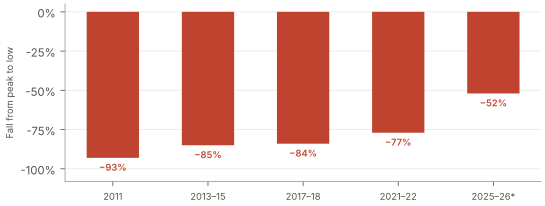
Bitcoin hit a record of about $126,000 in October 2025, then lost around half its value over the following months, trading near $60,000 in mid-2026 and around $80,000 by November. A 50 percent fall is painful. But by bitcoin's own standards it was a gentle bear market, because earlier ones fell by 77 to 93 percent. Imagine your phone losing 80 percent of its value and the internet saying "this is normal, actually." That's crypto.
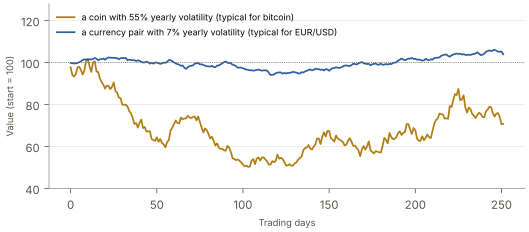
The point isn't that bitcoin is bad. It's that a normal day in bitcoin can move as much as a big month in a major currency pair. Everything in this course about position sizing exists because of that chart.
The price of one coin tells you almost nothing. You can buy $5 of bitcoin. A coin that costs $0.002 isn't "cheaper" than bitcoin; it just has more units. What matters is what you're buying and how much the whole network is worth, which is what Chapter 5 explains.
Key terms from this lesson
- Halving
- the cut in Bitcoin's block reward, roughly every four years.
- Satoshi (sat)
- the smallest unit of bitcoin, 0.00000001 BTC.
- Miner
- a computer, or company, that adds blocks to Bitcoin using proof of work.
- Spot ETF
- an exchange-traded fund that holds the actual asset, such as bitcoin, and trades on a stock market.
- Bear market
- a long period of falling prices.
- Volatility
- how much and how fast a price moves.
Learn this in a 5-minute interactive lesson
Real charts and practice questions. Free, no sign-up needed.
Related guides
Pajama Markets provides education, not financial advice. Trading forex, crypto and leveraged products carries a high risk of losing money. Practise on a demo account first.