Crypto Trading · lesson 1 of 29
What Crypto Actually Is
Learn this in a 5-minute interactive lesson
Real charts and practice questions. Free, no sign-up needed.
Money is a list
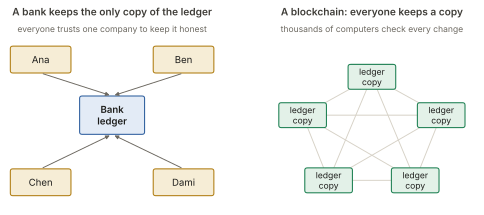
When you send money with a banking app, nothing physical moves. Your bank changes two numbers in its records: yours goes down, the other person's goes up. Money in a bank is really just an entry in a big list, called a ledger, and the bank's job is to keep that list honest.
That works fine, as long as you trust the bank. But it means one company decides whether your payment goes through, can freeze your account, charges you for sending money abroad, and keeps the only copy of the list.
The problem Bitcoin solved
Digital things are easy to copy. You can send the same photo to a hundred people and still have it. If money were just a digital file, you could spend the same coin twice. That's called the double-spending problem, and it's why digital money always needed a bank in the middle to keep score.
On 31 October 2008, in the middle of the global financial crisis, someone using the name Satoshi Nakamoto published a nine-page paper describing "a peer-to-peer electronic cash system" called Bitcoin. The idea was a ledger that thousands of computers around the world keep copies of and check together, so nobody can spend the same coin twice and nobody needs to trust a single company. That shared, public ledger is called a blockchain.
The network went live on 3 January 2009. Satoshi hid a newspaper headline in the very first block: "Chancellor on brink of second bailout for banks." It was a not-very-subtle comment on what Satoshi thought of the banking system. Then, in 2011, Satoshi stopped posting and vanished. Nobody knows who they were, and the million or so bitcoin believed to be theirs have never moved, which makes them both the most successful inventor and the most committed ghost in financial history.
From pizza to trillions
For the first year or so, bitcoin was worth almost nothing. On 22 May 2010, a programmer named Laszlo Hanyecz paid 10,000 bitcoin for two pizzas. At $80,000 per bitcoin, that's $800 million worth of pizza. Crypto fans still celebrate 22 May as "Bitcoin Pizza Day," and Laszlo has said he doesn't regret it, which is either very wise or very polite.
Since then, thousands of other cryptocurrencies, or crypto-assets, have been created. In 2026 the whole market has been worth somewhere around two to three trillion US dollars, depending on the month, which is a lot of pizza.
Coins and tokens
You'll hear two words used a lot:
- A coin is the native asset of its own blockchain. Bitcoin (BTC) is the coin of the Bitcoin blockchain; ether (ETH) is the coin of Ethereum.
- A token is an asset created on top of an existing blockchain, usually by a smart contract (Chapter 4). USDC and many other tokens live on Ethereum, for example.
People often use "coin" for both, and nobody will arrest you for it.
What people actually use crypto for
Honest answer: lots of things, and a large share of all activity is speculation, people buying because they hope the price will go up. But there are real uses too:
- Sending money across borders, often faster and cheaper than banks, especially with stablecoins.
- Saving in something other than a weak local currency. In countries with high inflation, some people hold bitcoin or dollar stablecoins instead.
- Holding a digital dollar without a US bank account, using stablecoins (Chapter 5).
- Using financial apps without a bank, such as lending, borrowing, and swapping tokens through DeFi (Part IV).
- Long-term investing, treating bitcoin as a scarce digital asset, sometimes called "digital gold."
- Trading, which is what most of this course is about.
Most blockchains are public. Every transaction, every amount, and every address can be seen by anyone, forever. Your name isn't written on the blockchain, but once an address is linked to you, for example through an exchange that knows who you are, your whole history can be traced. Police and analytics firms do this every day. It's more like writing under a pen name in public than wearing an invisibility cloak.
Criminals do use crypto, just as they use cash and bank accounts. But blockchain analytics firms that track this estimate that illegal activity is a small share of all crypto transactions. And because the records are public, crypto can actually be harder for criminals to hide than cash. Scams aimed at ordinary people are a huge problem, though, which is why Chapter 27 exists.
Key terms from this lesson
- Ledger
- a record of who owns what and who paid whom.
- Double-spending problem
- the risk of spending the same digital money twice.
- Blockchain
- a shared, public ledger kept and checked by many computers.
- Cryptocurrency (crypto-asset)
- a digital asset recorded on a blockchain.
- Coin
- the native asset of its own blockchain, such as BTC or ETH.
- Token
- an asset created on top of an existing blockchain.
Learn this in a 5-minute interactive lesson
Real charts and practice questions. Free, no sign-up needed.
Related guides
Pajama Markets provides education, not financial advice. Trading forex, crypto and leveraged products carries a high risk of losing money. Practise on a demo account first.