Crypto Trading · lesson 20 of 29
Lending, Staking, and Yield Explained
Learn this in a 5-minute interactive lesson
Real charts and practice questions. Free, no sign-up needed.
Lending and borrowing
On DeFi lending apps, such as Aave, people supply crypto to a pool and earn interest, and other people borrow from the pool and pay interest. Borrowers must deposit collateral worth more than they borrow, because there's no credit check and nobody to chase them if they don't pay back.
If the value of a borrower's collateral falls too far, the smart contract liquidates some of it automatically to repay the loan. Most apps show a health factor: above 1 you're safe, and at 1 you start being liquidated.
Alex deposits 1 ETH (worth $2,400) and borrows $1,200 of USDC. The app's liquidation threshold is 82.5%, meaning the loan can be up to 82.5 percent of the collateral's value before liquidation starts.
Liquidation happens when the collateral is worth $1,200 ÷ 0.825 = $1,454.55.
So if ETH falls from $2,400 to about $1,455, a drop of about 39 percent, Alex's ETH starts being sold to repay the loan, with a penalty on top. In crypto, 39 percent is not a fantasy. It's a bad month.
Staking
On proof-of-stake blockchains like Ethereum and Solana, you can stake coins to help secure the network and earn rewards. Running your own Ethereum validator needs 32 ETH and technical skills, so most people stake through an exchange or a staking pool. In recent years, ETH staking has paid roughly 2 to 4 percent a year, though the rate changes.
Liquid staking lets you stake and receive a token representing your staked coins, such as stETH, which you can still trade or use in DeFi. It's convenient, but it adds layers of risk: the staking provider, the smart contract, and the chance that the liquid token trades below the coin it represents when markets panic.
Earn products on exchanges
Centralised exchanges offer "Earn," "Savings," or "Staking" products with yields. Some simply pass on genuine staking rewards. Others lend your coins out to traders and companies. Either way, you're trusting the exchange.
In 2022, Celsius, a crypto lending company that promised high yields to more than a million customers, froze withdrawals and went bankrupt, after losing customers' money on risky bets and loans. Several other lenders, including BlockFi and Voyager, collapsed the same year. Customers who thought they were "saving" were really making unsecured loans to companies taking huge risks.
Where does the yield come from?
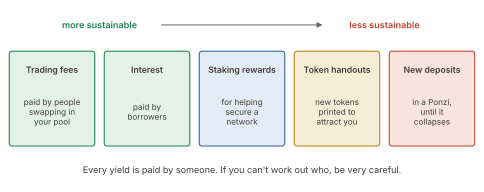
Every yield is paid by someone. Before you deposit anything, ask who that is:
- Trading fees paid by people using a pool you've supplied.
- Interest paid by borrowers.
- Staking rewards, from new coins and network fees.
- Token handouts: new tokens printed by a project to attract deposits. These yields often look enormous at first and shrink as the token price falls.
- New depositors' money, in a Ponzi scheme, which works perfectly right up until it doesn't.
If an app offers 20 percent a year on a stablecoin and you can't work out who's paying it, there's a good chance the answer is "the people who deposit after you."
APR and APY
- APR (annual percentage rate) is the simple yearly rate, without compounding.
- APY (annual percentage yield) includes compounding, the interest earning interest.
A 10% APR paid daily and reinvested gives (1 + 0.10 ÷ 365)<sup>365</sup> − 1 ≈ 10.52% APY. Projects often show whichever number looks bigger. Compare like with like.
The risks, in one list
- Smart-contract risk: a bug or hack drains the pool.
- Depeg risk: the stablecoin or liquid-staking token you hold drops below its value.
- Liquidation risk: a price drop forces the sale of your collateral.
- Lock-up risk: you can't withdraw for a set period, or there's a queue to get out.
- Company risk: the exchange or lender fails, as Celsius did.
- Token risk: the reward token you're paid in falls in value faster than you earn it.
Key terms from this lesson
- Collateral
- assets deposited to secure a loan.
- Health factor
- a measure of how close a DeFi loan is to liquidation.
- Liquidation threshold
- the loan-to-collateral level at which liquidation starts.
- Staking
- locking coins to help secure a proof-of-stake network in return for rewards.
- Liquid staking
- staking that gives you a tradable token representing your staked coins.
- APR / APY
- annual rates without and with compounding.
Learn this in a 5-minute interactive lesson
Real charts and practice questions. Free, no sign-up needed.
Related guides
Pajama Markets provides education, not financial advice. Trading forex, crypto and leveraged products carries a high risk of losing money. Practise on a demo account first.