Crypto Trading · lesson 21 of 29
Tokenomics and On-Chain Data Explained
Learn this in a 5-minute interactive lesson
Real charts and practice questions. Free, no sign-up needed.
Tokenomics
Tokenomics means the economics of a token: how many exist, who owns them, how many more are coming, and what the token is actually for. Two projects with similar technology can have completely different prospects because of their tokenomics.
The questions to ask:
- Supply: what's the circulating supply, the total supply, and is there a maximum?
- Inflation: how many new tokens are created each year, for example as staking rewards?
- Distribution: what share went to the team, early investors, the treasury, and the public?
- Unlocks: when do locked tokens become tradable?
- Utility: what is the token actually used for? Paying fees, voting, staking, or nothing much?
- Burns and buybacks: does anything take tokens out of circulation?
Unlocks and vesting
Team members and early investors usually receive tokens that vest over time, so they can't sell everything on launch day. A common pattern is a cliff, where nothing unlocks for the first year, followed by monthly unlocks.
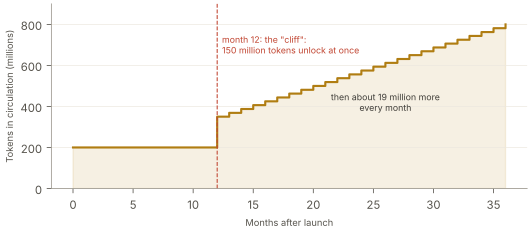
Token X has 200 million tokens in circulation at $2.00, a market cap of $400 million. A cliff unlocks 150 million more.
If the market cap stayed the same, the new price would be $400 million ÷ 350 million = $1.14, a fall of about 43 percent.
In reality, not every unlocked token is sold and the price might hold up better, or worse. But big unlocks add a lot of potential sellers, and many traders avoid holding a token in the weeks around a large one. Unlock calendars are published on several crypto data websites.
Who owns it?
On most blockchains, you can see how a token's supply is spread across wallets. If the top ten wallets hold 70 percent of the supply, a handful of people can crash the price whenever they like. Some of those big wallets are exchanges or smart contracts, which is fine. Others are the team, early investors, or one anonymous address that bought half the supply in the first minute, which is not.
On-chain data
Because blockchains are public, analysts can track things no stock market would ever show you:
- Exchange inflows and outflows: large amounts of a coin moving onto exchanges can mean holders are preparing to sell. Large amounts moving off exchanges often mean people are moving to long-term storage.
- Whale wallets: big holders' moves are often tracked and posted online within minutes.
- Stablecoin supply: growing stablecoin supply can mean more "dry powder" ready to buy crypto; shrinking supply can mean money leaving.
- Active addresses and fees: a rough sense of how much a network is actually being used.
On-chain data is a useful extra clue, not a crystal ball. A big transfer to an exchange might be a sale, or it might just be an exchange moving coins between its own wallets.
- 1.Find the token's official contract address from the project's own website or a major data site.
- 2.Look up circulating supply, total supply, market cap, and FDV. If FDV is many times the market cap, lots of supply is still coming.
- 3.Find the unlock schedule and check for big unlocks in the next few months.
- 4.Open the token on a block explorer and look at the top holders. Are they exchanges and contracts, or a few unknown wallets?
- 5.Check liquidity: how much is in its trading pools, and how big a sale would move the price.
- 6.Ask what the token is for. If the honest answer is "going up," be careful.
Key terms from this lesson
- Tokenomics
- the supply, distribution, and use of a token.
- Vesting
- releasing tokens to their owners gradually over time.
- Cliff
- a period during which no tokens unlock, often followed by a large unlock.
- Emissions
- new tokens created over time, for example as rewards.
- Whale
- a holder with a very large amount of a coin.
- Exchange inflow / outflow
- coins moving onto or off exchanges.
Learn this in a 5-minute interactive lesson
Real charts and practice questions. Free, no sign-up needed.
Related guides
Pajama Markets provides education, not financial advice. Trading forex, crypto and leveraged products carries a high risk of losing money. Practise on a demo account first.