Crypto Trading · lesson 23 of 29
Risk Management in a 24/7 Market Explained
Learn this in a 5-minute interactive lesson
Real charts and practice questions. Free, no sign-up needed.
Survive first
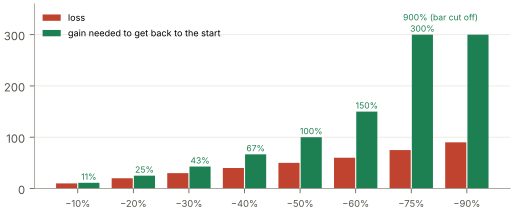
Crypto rewards people who are still around when the good times come, and wipes out people who bet too much in the bad ones. The first job of every trader is to make sure no single trade, and no bad week, can knock them out.
Risk a small, fixed amount
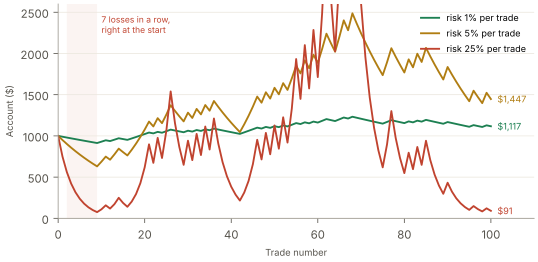
The standard rule is to risk a small, fixed percentage of your account on each trade, usually 1 percent, and almost never more than 2. While you're learning, 0.5 to 1 percent is ideal.
"Risk 1 percent" means: if the stop loss is hit, I lose 1 percent of my account. On a $1,000 account, that's $10. It doesn't mean you can only buy $10 of bitcoin. Chapter 24 shows you how big the position can be.
Stops that fit crypto
Crypto is much more volatile than currencies or most shares, so stops have to be wider. A stop 0.3 percent below your entry on bitcoin will be hit by normal noise within minutes. Typical stops on the 4-hour chart might be 2 to 5 percent on bitcoin, 3 to 7 percent on ether, and 8 to 20 percent on smaller coins. That's fine, as long as your position size shrinks to match, so the money at risk stays at 1 percent.
Put your stop where your trade idea is proved wrong: beyond the support zone or swing low for a buy, beyond the resistance zone or swing high for a sell, plus a buffer for wicks. Some traders use the Average True Range (ATR), an indicator that measures how far a coin normally moves per candle, to size that buffer. And once a trade is open, you can move your stop closer, but never further away.
R, reward-to-risk, and break-even
1R is the amount you risked. A win of $25 on a $10 risk is +2.5R. The reward-to-risk ratio compares your target distance with your stop distance.
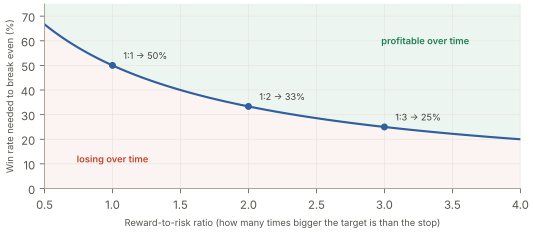
Break-even win rate = 1 ÷ (1 + reward-to-risk). At 1:2 that's 33 percent, and at 1:3 it's 25 percent. Fees push the real number up a little.
Expectancy
Expectancy = (win rate × average win) − (loss rate × average loss)
A strategy wins 40% of trades, with an average win of 2R and an average loss of 1R.
Expectancy = (0.40 × 2) − (0.60 × 1) = +0.2R per trade.
At $10 per R, that's about $2 per trade on average, or roughly $200 over 100 trades, before fees. Small, positive, and repeatable is exactly what you want. A negative expectancy can't be fixed with confidence, vibes, or a bigger position.
Losing streaks happen
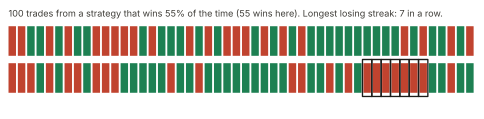
At 1 percent risk, seven losses costs about 7 percent. At 10 percent risk, the same streak takes about half the account, and most people quit a good strategy right before it recovers.
Crypto's extra risks
- Everything is connected. Most coins move with bitcoin. Long positions on ETH, SOL, and three other altcoins aren't five trades; they're roughly one bet that the market goes up. Count them together.
- The market never closes. Price can hit your level at 3 a.m. Always have a stop order in place, not a mental note.
- Exchange risk. Spread your money across more than one exchange and keep long-term holdings in your own wallet.
- Concentration. Don't put most of your money in one small coin, however much you love the logo.
- Leverage. Chapter 17's liquidation maths applies every single time.
Rules that keep you alive
- Risk 1 percent or less per trade.
- Keep total open risk at 3 percent or less, counting correlated trades as one idea.
- Stop for the day after two losses, and for the week after a 5 percent drawdown.
- Never add to a losing trade, and never remove a stop.
Key terms from this lesson
- Risk per trade
- the amount you lose if a trade hits its stop, usually a percentage of the account.
- R
- a unit equal to the amount risked on a trade.
- Reward-to-risk ratio
- the size of the target compared with the size of the stop.
- Expectancy
- the average result per trade over many trades.
- Average True Range (ATR)
- an indicator showing how far price typically moves per candle.
- Drawdown
- a fall in the account from its highest point.
- Correlation
- the tendency of two assets to move together.
Learn this in a 5-minute interactive lesson
Real charts and practice questions. Free, no sign-up needed.
Related guides
Pajama Markets provides education, not financial advice. Trading forex, crypto and leveraged products carries a high risk of losing money. Practise on a demo account first.