Crypto Trading · lesson 18 of 29
Funding, Open Interest, and Liquidations Explained
Learn this in a 5-minute interactive lesson
Real charts and practice questions. Free, no sign-up needed.
Funding: what keeps perps honest
A perpetual future never expires, so something has to stop its price drifting away from the real spot price. That something is the funding rate: a small payment exchanged between longs and shorts, usually every 8 hours (some exchanges use 1 or 4 hours).
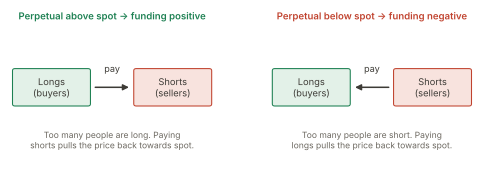
- Positive funding: the perp is trading above spot, usually because lots of people are long. Longs pay shorts.
- Negative funding: the perp is below spot, usually because lots of people are short. Shorts pay longs.
The exchange doesn't keep the funding. It moves from one group of traders to the other.
You hold a $10,000 long position. Funding is +0.01% every 8 hours, a common resting level.
Each payment: $10,000 × 0.0001 = $1. Three times a day: $3 a day. Over a year, that would be about $1,095, roughly 11 percent of the position.
In a frenzy, funding can reach 0.1% every 8 hours. Then the same position costs $30 a day. Holding a leveraged long for weeks in an overheated market can cost more in funding than you make from the price.
Funding as a clue
Very high positive funding tells you many traders are betting on a rise, often with leverage. That can mean the trade is crowded: if the price starts to fall, all those longs may rush to get out at once. Very negative funding tells you the opposite: lots of people are short, and a rise could force them out. Funding isn't a buy or sell signal by itself, but it tells you who's leaning which way.
Open interest
Open interest (OI) is the total value of all futures positions that are currently open. Every position has a long and a short side, so OI tells you how much leveraged money is in the market, not which way it's betting.
- Price rising with OI rising: new money is opening positions and pushing the price up.
- Price rising with OI falling: shorts are closing (or being forced out), which can fuel sharp but short-lived moves.
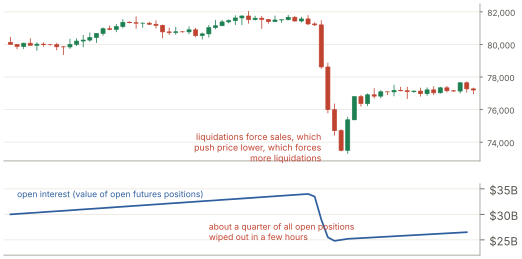
- A sudden collapse in OI: a wave of positions has been closed or liquidated.
Cascades and squeezes
When lots of leveraged longs have liquidation prices in the same area, a drop into that area forces their positions to be sold, which pushes the price lower, which triggers the next group of liquidations. That's a liquidation cascade, or long squeeze. On 10 October 2025, a cascade like this liquidated roughly $19 billion of positions in about a day.
A short squeeze is the opposite: price rises, shorts are forced to buy back, and their buying pushes the price higher still. Squeezes explain a lot of crypto's sudden, violent candles. They're also why you should never keep your stop loss right next to an obvious cluster of other people's.
Negative funding means you'd be paid to hold a long, but only a small amount, and it's usually negative for a reason: lots of traders expect the price to fall. A 0.01% funding payment won't help much if the price drops 8%. Funding is a cost or a bonus on top of a trade, not a reason to take one.
Key terms from this lesson
- Funding rate
- a regular payment between longs and shorts that keeps a perpetual's price close to spot.
- Open interest (OI)
- the total value of open futures positions.
- Crowded trade
- a position held by so many traders that a reversal can trigger a rush for the exit.
- Liquidation cascade (long squeeze)
- a chain of liquidations that pushes the price further down.
- Short squeeze
- a rapid rise as short sellers are forced to buy back.
Learn this in a 5-minute interactive lesson
Real charts and practice questions. Free, no sign-up needed.
Related guides
Pajama Markets provides education, not financial advice. Trading forex, crypto and leveraged products carries a high risk of losing money. Practise on a demo account first.