Crypto Trading · lesson 17 of 29
Futures, Perpetuals, and Leverage Explained
Learn this in a 5-minute interactive lesson
Real charts and practice questions. Free, no sign-up needed.
Trading a contract instead of the coin
On the spot market, you buy the actual coin. If bitcoin goes to zero, you lose what you paid, and no more. On the futures market, you trade a contract whose value follows the coin's price, usually with leverage. You don't own any bitcoin. You just make or lose money as the price moves.
The most popular kind in crypto is the perpetual future, or "perp." Unlike traditional futures, it never expires, so you can hold it as long as you like, as long as you keep enough margin and pay or receive funding (Chapter 18). Perps let you:
- go long (profit if the price rises) or short (profit if it falls);
- use leverage, controlling a bigger position than your money.
Many countries restrict crypto derivatives for retail traders. In the UK, for example, the FCA has banned the sale of crypto derivatives to retail customers since January 2021, and in the US, offshore perp exchanges aren't allowed to serve American customers. Check the rules where you live. Using a VPN to get round them can get your account, and your money, frozen.
Margin and leverage
Margin is the money you put up to open a leveraged position. Leverage tells you how big the position is compared with the margin.
margin = position size ÷ leverage
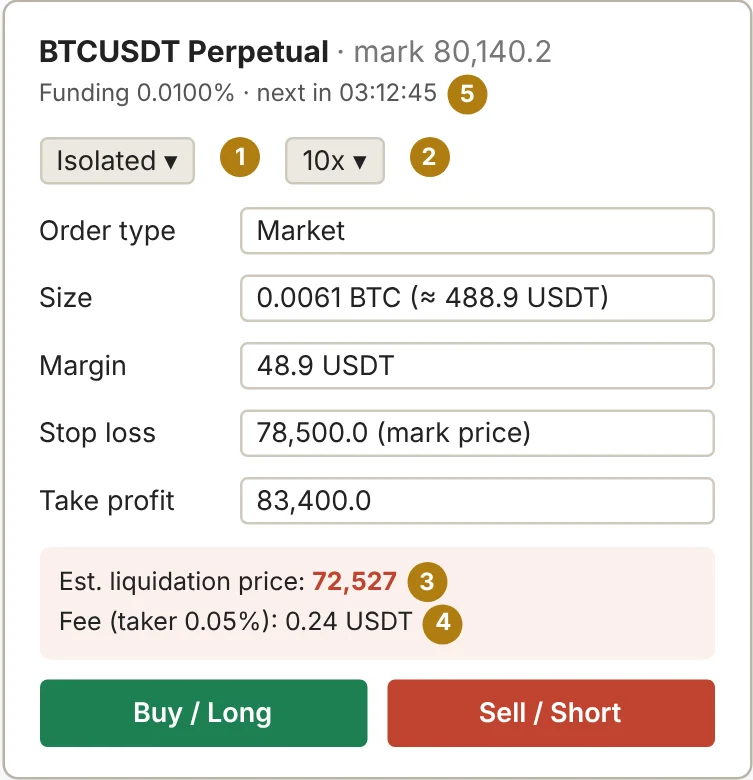
Alex has a $1,000 futures account and opens a $5,000 long position on BTC at $80,000, with 10x leverage and isolated margin.
Margin: $5,000 ÷ 10 = $500. Size in bitcoin: $5,000 ÷ $80,000 = 0.0625 BTC.
If BTC rises 2% to $81,600: profit = 0.0625 × 1,600 = $100, which is 20% of the margin. If BTC falls 2% to $78,400: loss = $100. If BTC falls 5%: loss = $250, half the margin.
The fee is charged on the full $5,000, not the $500. At a 0.05% taker fee, that's $2.50 to open and about $2.50 to close.
Liquidation
If your losses eat through almost all of your margin, the exchange closes your position automatically. That's a liquidation, and the margin is gone. Exchanges keep a small extra cushion called the maintenance margin, so you're liquidated slightly before your margin hits zero.
A simplified way to estimate the liquidation price of a long position with isolated margin is:
liquidation price ≈ entry × (1 − 1 ÷ leverage + maintenance margin rate)
With a maintenance margin rate of 0.5 percent, a 10x long at $80,000 is liquidated at about 80,000 × (1 − 0.10 + 0.005) = $72,400, a fall of about 9.5 percent. Real exchanges use slightly more complicated formulas, and the order panel always shows the estimate. Read it every time.
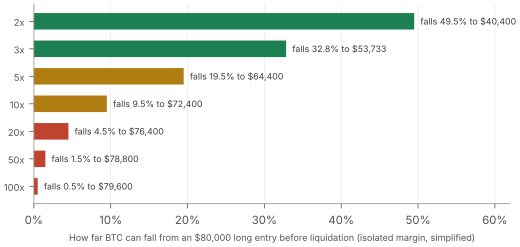
A normal day in bitcoin can easily include a 2 to 4 percent move. At 50x or 100x leverage, you're not trading. You're buying a lottery ticket that expires the next time someone in another time zone sneezes.
Mark price
Exchanges usually trigger liquidations using a mark price, an average of prices from several exchanges, rather than the last traded price on their own exchange. That stops one strange trade on one exchange from wiping everyone out. It also means your liquidation can happen even if the chart you're looking at didn't quite touch the level, or not happen when it did. Many exchanges let you choose whether your stop loss triggers on the mark price or the last price.
Isolated and cross margin
- Isolated margin: each position has its own margin. If it's liquidated, you only lose the margin in that position. Easier to control.
- Cross margin: all your positions share your whole futures balance as margin. A losing position can drag on everything in the account before liquidation, so a bad trade can take your whole balance with it.
While you're learning, use isolated margin, and keep only the money you need for trading in the futures account.
Your stop must come first
The most important rule in this chapter: your stop loss must be well before your liquidation price. The stop is where you decided you were wrong. The liquidation price is where the exchange decides for you, and it takes your whole margin. If your stop is beyond your liquidation price, you don't have a stop, you have a wish. Size the position using the method in Chapter 24 first, and only then choose a leverage setting that keeps the liquidation price far away from the stop.
Kevin opened a 100x long on bitcoin with $200 because "it only needs to go up 1% and I double my money." The price dipped 0.6% before going up. He was liquidated in four minutes, watched bitcoin rise 3% over the next hour, and told everyone the market was rigged. It wasn't rigged. At 100x, a completely normal wiggle is fatal.
Key terms from this lesson
- Spot market
- where the actual coins are bought and sold.
- Futures contract
- a contract whose value follows an asset's price, often traded with leverage.
- Perpetual future (perp)
- a futures contract with no expiry date, kept in line with spot by funding payments.
- Margin
- the money put up to open a leveraged position.
- Maintenance margin
- the minimum margin needed to keep a position open.
- Liquidation price
- the price at which a leveraged position is force-closed.
- Mark price
- a fair price, often averaged across exchanges, used to trigger liquidations.
- Isolated / cross margin
- margin kept separate for each position, or shared across the whole account.
Learn this in a 5-minute interactive lesson
Real charts and practice questions. Free, no sign-up needed.
Related guides
Pajama Markets provides education, not financial advice. Trading forex, crypto and leveraged products carries a high risk of losing money. Practise on a demo account first.