Money Foundations · lesson 7 of 28
Purchasing Power and the Price Level Explained
Learn this in a 5-minute interactive lesson
Real charts and practice questions. Free, no sign-up needed.
Prices going up, or money going down?
Purchasing power is how much one unit of money can buy. If a loaf of bread costs one dollar this year and two dollars next year, and it's exactly the same loaf, your dollar now buys half as much bread. The bread didn't get any better. Your dollar got smaller.
Most people describe this as "prices going up," and that's true. It's just half the picture. The other half is that the value of money went down. Rising prices and falling purchasing power are the same event looked at from opposite ends.
One price, or all of them?
A single price can change for reasons that have nothing to do with money. Avocados get pricey after a bad harvest. Flights cost a fortune during school holidays because airlines know exactly what they're doing. TVs get cheaper every year as the technology improves. These are changes in relative prices: one thing getting more or less expensive compared with everything else.
The general price level is the average price across a broad range of goods and services. When it rises, most prices are rising together, which suggests something is going on with the money itself or the whole economy, not just one market. Expensive avocados are a relative-price story. Everything getting expensive at once is a money story.
How it's measured: the consumer price index
Government statisticians track the general price level with a consumer price index (CPI). The idea is simple enough:
- 1.Pick a basket of things a typical household buys: food, rent, transport, clothes, phone plans, haircuts, streaming subscriptions, and so on.
- 2.Work out what that basket costs in a chosen base period and call it 100.
- 3.Price the same basket again later and express the cost relative to the base.
If the basket cost 100 in the base year and 112 two years later, the index is 112, and the price level has gone up 12 percent.
Every CPI has flaws, and statisticians will happily list them if you give them the chance. The basket changes as habits change: a 1985 basket had camera film in it, and a 2026 basket has cloud storage. Quality changes too, since today's phone does more than a whole office could in 1990. And sometimes prices rise in disguise. When a chocolate bar quietly drops from 200 grams to 180 grams at the same price, that's a 10 percent price rise with a fake moustache on. It's called shrinkflation, and good statistics agencies try to catch it. Your own spending might not look like the "typical" basket either. Even so, the CPI is the best public measure we have, so this course treats it as a careful guide rather than gospel.
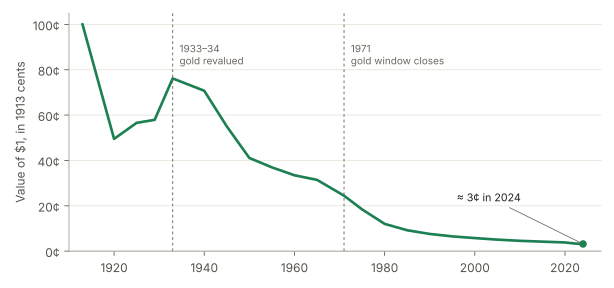
A century of the US dollar
By the US consumer price index, a basket of goods that cost $1.00 in 1913 cost about $31.70 in 2024. Put the other way round, $100 in 2024 bought about as much as $3.15 did in 1913. The dollar was in use the entire time, and wages rose enormously over the century, so people weren't thirty times poorer. Each dollar, though, became a much smaller claim on goods. Your great-grandparents could buy lunch with a dollar. You can buy a sticker of a lunch.
Nominal and real values
A nominal value is stated in the money of its own time. A real value has been adjusted for price changes so you can compare different years fairly. Your payslip shows nominal numbers. What you can actually afford at the shop is the real number.
Maya is a graphic designer. Last year she earned €4,000 a month. This year she earns €4,400. Over the same period the CPI rose from 150 to 162.
Nominal increase: (4,400 − 4,000) ÷ 4,000 × 100 = 10 percent.
Inflation: (162 − 150) ÷ 150 × 100 = 8 percent.
Real salary this year, in last year's prices: 4,400 × (150 ÷ 162) = €4,074.
Real increase: (4,074 − 4,000) ÷ 4,000 × 100 ≈ 1.9 percent.
Maya's boss announced a 10 percent raise like he was donating a kidney. In terms of what her salary actually buys, she got less than 2 percent. If prices had gone up 12 percent, her real pay would have fallen despite the "raise." So whenever someone quotes you a number, ask whether it's real or nominal.
Percentage change and percentage points
These two trip up almost everyone, including quite a few journalists.
Percentage change = (new value − old value) ÷ old value × 100. A price going from 50 to 60 has risen 20 percent.
Percentage-point change is just the difference between two percentages. If inflation goes from 4 percent to 6 percent, it's up 2 percentage points. It's also up 50 percent, because 2 is half of 4. Both statements are true and they mean very different things. Politicians who want inflation to sound small tend to use percentage points; their opponents, who want it to sound terrifying, tend to use percentages. Now you'll notice both.
Percentage changes also compound, meaning they multiply rather than add. A price that goes up 10 percent and then down 10 percent doesn't end up where it started. From 100 it goes to 110, then drops 11 to 99. Somewhere, a shop that "cut prices by 10 percent" after "raising them 10 percent" is still slightly ahead.
Key terms from this lesson
- Purchasing power
- the quantity of goods and services one unit of money can buy.
- Relative price
- the price of one good compared with others.
- General price level
- the average price of a broad basket of goods and services.
- Consumer price index (CPI)
- an index tracking the cost of a fixed basket of consumer goods over time.
- Shrinkflation
- reducing the size of a product while keeping its price, a hidden price increase.
- Nominal value
- a value stated in the money of its own period.
- Real value
- a value adjusted for changes in the price level.
- Percentage point
- the arithmetic difference between two percentages.
Learn this in a 5-minute interactive lesson
Real charts and practice questions. Free, no sign-up needed.
Related guides
Pajama Markets provides education, not financial advice. Trading forex, crypto and leveraged products carries a high risk of losing money. Practise on a demo account first.