Money Foundations · lesson 8 of 28
Inflation and Deflation Explained
Learn this in a 5-minute interactive lesson
Real charts and practice questions. Free, no sign-up needed.
What inflation actually means
Inflation is a sustained rise in the general price level. Each part of that definition matters. Sustained means it keeps going, not a one-off jump. General means it affects a wide range of prices, not just concert tickets. Price level means it's measured across a whole basket, usually with a CPI.
Deflation is the reverse: a sustained fall in the general price level. Disinflation is something else again, a slowdown in inflation. Prices are still rising, just more slowly. So when a government says "inflation is falling," it usually means disinflation. Your shopping isn't getting cheaper. It's getting more expensive a bit less quickly than before, which is less exciting to hear.
The usual suspects
"Inflation" tells you what happened to the price tags. On its own, it doesn't tell you why. To work that out, ask two things: did the amount of money and spending go up, and did the amount of stuff available go down or fail to keep up? Economists group the causes into four families.
Demand-pull inflation. Total spending grows faster than the economy can produce. There's more money chasing the same amount of stuff, so sellers raise prices because they can. Picture what happens to concert tickets when a superstar announces a tour, and then picture it happening to everything.
Cost-push inflation. It gets more expensive to make things, and producers pass the cost on. An oil-price shock, a drought that ruins a harvest, or a war that shuts down shipping routes can all push prices up even if the amount of money hasn't changed at all.
Money and credit growth. If the amount of money and credit grows much faster than the economy's output for a long time, prices tend to rise. Chapter 12 looks at this more formally.
Expectations. If workers and businesses expect prices to rise 10 percent next year, workers ask for 10 percent more pay and businesses raise prices in advance. That means inflation can keep going after whatever started it has disappeared, like a party that carries on after the host has gone to bed. It's a big reason central banks care so much about being believed.
Usually several suspects are guilty at once. The global inflation of 2021–2023 was very much a group project: a burst of spending as pandemic restrictions lifted, tangled supply chains, an energy-price spike after Russia invaded Ukraine, and big increases in money and credit during 2020–2021. US consumer price inflation peaked at 9.1 percent in June 2022, the highest in forty years. The eurozone went above 10 percent later that year, and the UK passed 11 percent. People who'd never given inflation a thought suddenly couldn't stop talking about it.
Who loses and who wins
Inflation doesn't hit everyone the same way. If you hold cash, or savings earning less than inflation, you lose purchasing power. If your wages adjust slowly, you lose for as long as your pay lags behind prices. Meanwhile, people with fixed-rate loans can come out ahead, because they repay with money that buys less than the money they borrowed. In effect, inflation moves wealth from savers to borrowers, and nobody votes on it. Chapter 23 comes back to this.
Deflation: when cheaper is worse
Falling prices sound great when you're shopping, and when they come from better technology, as with TVs and laptops, they are. A general, sustained fall in prices across the whole economy is a different story.
When people expect prices to keep falling, they put off buying things. Why buy a car now if it'll be cheaper next year? Less spending pushes prices down further. Debts get heavier in real terms, because borrowers owe fixed amounts of money that are each worth more. Businesses cut wages and jobs. The whole economy can slide into a slow, gloomy spiral.
During the Great Depression, US consumer prices fell about 24 percent between 1929 and 1933, while unemployment climbed to around a quarter of the workforce. Japan had milder but stubborn deflation in many years between the late 1990s and the early 2010s, a stretch often called the "lost decades." Cheap prices didn't feel like much of a party there either.
Why central banks aim for about 2 percent
Most big central banks now target inflation of about 2 percent a year. New Zealand adopted the first formal inflation target in 1990, the US Federal Reserve announced an explicit 2 percent goal in 2012, and the European Central Bank, the Bank of England, and the Bank of Japan all target 2 percent today. So why not aim for zero, which sounds tidier?
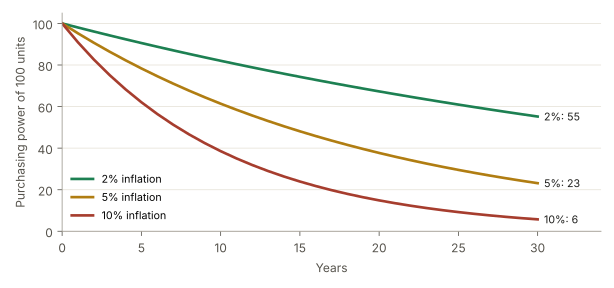
There are three main reasons. First, price indexes probably overstate inflation a little because they don't fully capture quality improvements, so a measured zero might really be deflation. Second, a bit of positive inflation gives a cushion against the deflation spiral described above. Third, it leaves central banks room to cut interest rates in a downturn, as Chapter 16 explains. Critics point out that even 2 percent a year chips away at savings, halving the purchasing power of money in about 35 years. Both sides have a fair point.
To estimate how long it takes prices to double, divide 70 by the annual inflation rate.
- At 2 percent inflation: 70 ÷ 2 = 35 years.
- At 7 percent: 70 ÷ 7 = 10 years.
- At 35 percent: 70 ÷ 35 = 2 years.
The same rule tells you how fast cash loses half its purchasing power. It's an approximation and works best below about 15 percent. Above that, the arithmetic is the least of your worries.
Companies do raise prices, sometimes cheekily. But greed doesn't explain why prices across a whole economy rise faster in some years than others. Corporate greed didn't switch on in 2022 and off again in 2015. Broad inflation comes from demand, costs, money and credit, and expectations. Pinning it on one villain, whether that's greedy companies or the money printer, makes for a satisfying post online and pretty poor economics.
Key terms from this lesson
- Inflation
- a sustained rise in the general price level.
- Deflation
- a sustained fall in the general price level.
- Disinflation
- a fall in the rate of inflation while prices are still rising.
- Demand-pull inflation
- inflation caused by spending growing faster than productive capacity.
- Cost-push inflation
- inflation caused by rising production costs.
- Inflation expectations
- what people believe future inflation will be; these beliefs influence wages and prices.
- Inflation target
- a central bank's stated goal for the inflation rate, commonly 2 percent.
Learn this in a 5-minute interactive lesson
Real charts and practice questions. Free, no sign-up needed.
Related guides
Pajama Markets provides education, not financial advice. Trading forex, crypto and leveraged products carries a high risk of losing money. Practise on a demo account first.