Forex Trading · lesson 25 of 33
The Economic Calendar and Trading the News Explained
Learn this in a 5-minute interactive lesson
Real charts and practice questions. Free, no sign-up needed.
Your weekly weather forecast
An economic calendar lists upcoming data releases and central-bank events, with the date, the time, the currency affected, and how much impact the event usually has. Your broker probably has one, MetaTrader 5 has one built in (in the Toolbox), and free websites like Forex Factory and Investing.com have popular versions. Check it at the start of each week and before every trade, the same way you'd check the weather before planning a picnic.
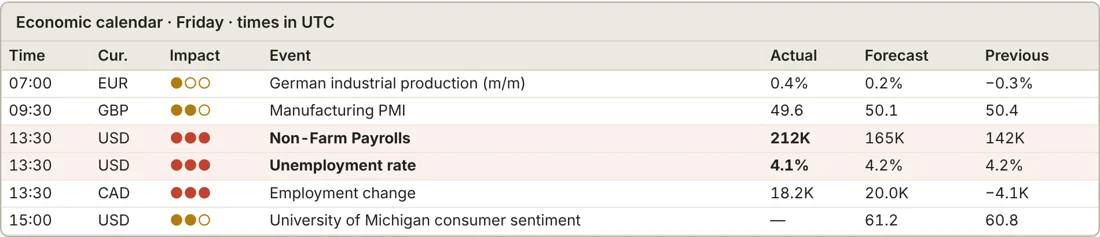
Actual, forecast, previous
Each release shows three numbers:
- Previous: last month's (or last quarter's) figure.
- Forecast: what economists expected this time. This is what the market has already priced in.
- Actual: the real number, which appears the moment it's released.
The market moves on the surprise: the difference between the actual and the forecast. In the calendar above, US non-farm payrolls came in at 212,000 jobs against a forecast of 165,000. That's a big positive surprise for the US economy, which makes higher US interest rates more likely, so the dollar would tend to rise. EUR/USD would tend to fall, and USD/JPY would tend to rise.
The releases that move markets most
- Interest-rate decisions, and especially the press conference afterwards.
- Inflation (CPI) figures.
- The US jobs report (non-farm payrolls), usually on the first Friday of the month at 8:30 a.m. New York time, which is 13:30 UTC in winter and 12:30 UTC in summer.
- GDP, PMIs, and retail sales.
- Speeches by central-bank heads, which can move markets with a single sentence.
- Unscheduled events: elections, wars, sudden political news, and the occasional social-media post from a world leader at 3 a.m.
What happens when the number comes out
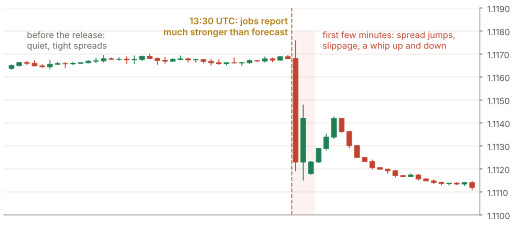
In the first few seconds and minutes after a big release:
- Spreads widen, sometimes to many times their normal size.
- Slippage gets worse. Your stop loss might be filled several pips beyond where you set it, because there was no price in between.
- Price whips up and down as traders react, change their minds, and react again.
A stop loss protects you most of the time, but in a really fast market it can be jumped over. That's not the broker cheating. It's what happens when there's simply nobody willing to trade at the prices in between.
How to handle news as a beginner
You have three sensible choices:
- 1.Stay out. Don't open new trades in the 30 minutes or so before a high-impact release on either currency in your pair, and consider closing short-term trades beforehand. This is the best option while you're learning.
- 2.Trade the aftermath. Wait 15 to 30 minutes for the dust to settle, spreads to return to normal, and a clear direction to appear on your chart, then use your normal strategy.
- 3.Hold through it, deliberately. Swing traders often hold trades through news because their stops are wide and their targets are far away. If you do this, make sure your position size already accounts for the possibility of slippage, and never add risk just before a release.
What you should never do is open a big position seconds before the number comes out and hope. That's not trading. It's a coin toss with a spread on top.
Kevin heard the jobs report "always moves the market 50 pips," so he opened 1 lot of EUR/USD ten seconds before the release with a 10-pip stop. The spread widened to 6 pips, price jumped, and his stop was filled 17 pips away instead of 10. Then the price went the way he'd guessed. He was right about the direction and still lost $170. The market doesn't pay you for guessing right. It pays you for managing risk while you're guessing.
On Sunday or Monday, open an economic calendar, filter it to high-impact events for USD, EUR, GBP, and JPY, and set it to your time zone. Write down the three biggest events of the week, with their times in your time zone and in your broker's server time. When each one comes out, look at the 5-minute chart of a related pair and note what happened to the price and the spread.
Key terms from this lesson
- Economic calendar
- a schedule of upcoming economic releases and events.
- Forecast (consensus)
- the figure economists expect for a release.
- Actual
- the real figure released.
- Surprise
- the difference between the actual figure and the forecast.
- Non-farm payrolls (NFP)
- the monthly US jobs report.
- High-impact event
- a release or event that usually moves prices sharply.
Learn this in a 5-minute interactive lesson
Real charts and practice questions. Free, no sign-up needed.
Related guides
Pajama Markets provides education, not financial advice. Trading forex, crypto and leveraged products carries a high risk of losing money. Practise on a demo account first.