Forex Trading · lesson 24 of 33
Interest Rates, Inflation, and Central Banks Explained
Learn this in a 5-minute interactive lesson
Real charts and practice questions. Free, no sign-up needed.
Money goes where it's treated best
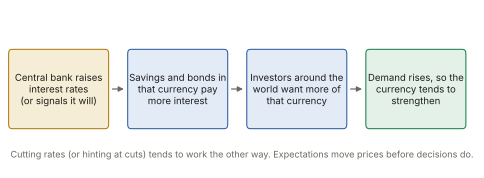
Imagine two savings accounts. One pays 1 percent a year and the other pays 5 percent. If they're equally safe, everyone wants the 5 percent one. Now imagine the accounts are in different currencies. To use the 5 percent account, investors have to buy that currency first. That extra demand pushes the currency up.
That's the heart of why interest rates move currencies. When a country's interest rates rise compared with other countries, its bonds and savings pay more, global investors want more of its currency, and the currency tends to strengthen. When its rates fall, the opposite tends to happen.
Who sets the rates
Each currency has a central bank that sets its main interest rate, called the policy rate. These are the ones forex traders watch most:
| Currency | Central bank | How often it decides on rates |
|---|---|---|
| USD | Federal Reserve (the Fed), through its FOMC | 8 scheduled meetings a year |
| EUR | European Central Bank (ECB) | About every six weeks |
| GBP | Bank of England (BoE) | 8 times a year |
| JPY | Bank of Japan (BoJ) | 8 times a year |
| CHF | Swiss National Bank (SNB) | 4 times a year |
| AUD | Reserve Bank of Australia (RBA) | 8 times a year |
| CAD | Bank of Canada (BoC) | 8 times a year |
| NZD | Reserve Bank of New Zealand (RBNZ) | 7 times a year |
Most of these central banks have a main job: keeping inflation (the rate at which prices rise) low and stable, usually around 2 percent a year. When inflation is too high, they raise rates to cool the economy down, because borrowing gets more expensive and people spend less. When the economy is weak and inflation is low, they cut rates to encourage borrowing and spending.
Hawks and doves
Traders describe central banks, and the people who run them, as birds:
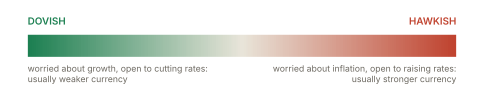
- A hawk worries most about inflation and is ready to raise rates or keep them high. Hawkish talk usually helps the currency.
- A dove worries most about growth and jobs, and is ready to cut rates. Dovish talk usually weakens the currency.
You'll hear lines like "the Fed sounded more hawkish than expected" on financial news. Translation: the Fed suggested rates might stay higher for longer than people thought, so the dollar went up.
Expectations move prices first
Here's the part that confuses everyone. Markets don't wait for a central bank to act. Traders spend all their time guessing what the bank will do next, and prices move on those guesses. By the time the decision actually comes out, it's often already priced in.
Everyone expects the Bank of England to raise rates by 0.25 percent, and GBP/USD has already climbed for two weeks in anticipation.
The bank raises rates by exactly 0.25 percent, as expected. But in the statement, it says this is "likely to be the last increase for now."
GBP/USD falls 80 pips. Why? The rise was already in the price. The surprise was that there'd be no more rises after it, which was more dovish than traders had hoped. This is where the saying "buy the rumour, sell the fact" comes from.
So the question to ask about any news isn't "is this good or bad?" It's "is this better or worse than the market expected?"
Inflation: good news or bad news?
In the short term, higher-than-expected inflation often makes a currency rise, because traders expect the central bank to respond with higher rates. In the long term, high inflation eats away at what a currency can buy, which weakens it. Both things can be true at once on different timeframes, which is part of why economics makes people argue at dinner parties.
Other numbers that matter
Interest rates and inflation are the big two. Traders also watch:
- Employment: in the US, the monthly jobs report (non-farm payrolls) and the unemployment rate.
- GDP: how fast the economy is growing.
- PMIs (purchasing managers' indices): surveys of businesses. Above 50 usually means growth, below 50 means shrinking.
- Retail sales: how much people are spending.
- Trade balance: exports minus imports.
All of these matter mostly because of what they might make the central bank do next.
The carry trade
A carry trade means buying a currency with a high interest rate against one with a low interest rate, holding it, and collecting the difference as a positive swap each night. For years, a favourite was borrowing in Japanese yen, which had almost zero interest rates, and buying higher-yielding currencies.
It can work quietly for months. The danger is what happens when everyone rushes for the exit at once. If the low-yielding currency suddenly jumps, perhaps because its central bank surprises everyone, months of small swap gains can disappear in days. In early August 2024, for example, a sudden unwinding of yen carry trades sent the yen sharply higher in a very short time and caused big losses for anyone caught on the wrong side. Traders sometimes describe carry trading as picking up coins in front of a steamroller, which is a good picture of how small the gains are compared with how fast the losses can arrive.
Key terms from this lesson
- Policy rate
- the main interest rate set by a central bank.
- Inflation
- the rate at which prices in an economy rise.
- Hawkish
- leaning towards higher interest rates to fight inflation.
- Dovish
- leaning towards lower interest rates to support growth.
- Priced in
- already reflected in the price, because the market expected it.
- Carry trade
- buying a high-interest currency against a low-interest one to earn the interest difference.
Learn this in a 5-minute interactive lesson
Real charts and practice questions. Free, no sign-up needed.
Related guides
Pajama Markets provides education, not financial advice. Trading forex, crypto and leveraged products carries a high risk of losing money. Practise on a demo account first.