Forex Trading · lesson 26 of 33
Risk Sentiment and Correlations Explained
Learn this in a 5-minute interactive lesson
Real charts and practice questions. Free, no sign-up needed.
The market's mood
Sometimes the whole market is feeling brave: stock markets are rising, investors are buying riskier assets, and everyone's looking for higher returns. That's called risk-on. Other times, something scary happens, such as a banking crisis, a war, or a sudden crash, and investors rush to put their money somewhere safe. That's risk-off.
Some currencies tend to do well in each mood:
| Mood | Currencies that tend to rise | Why |
|---|---|---|
| Risk-off (fear) | US dollar, Japanese yen, Swiss franc (and gold) | Seen as safe places to park money; deep markets; history of stability |
| Risk-on (confidence) | Australian dollar, New Zealand dollar, Canadian dollar, many emerging-market currencies | Linked to global growth, commodities, and higher interest rates |
These are tendencies, not laws of physics. The yen, for example, has sometimes failed to act as a safe haven when Japan's own interest rates were far below everyone else's. But on a day when headlines are full of panic, it's worth asking which way the mood is pushing before you buy AUD/JPY.
Commodity currencies
Some currencies are tied to the prices of things their countries export. The Australian dollar often moves with iron ore and with how China's economy is doing, because China buys a lot of Australian raw materials. The Canadian dollar tends to move with oil. The New Zealand dollar reacts to dairy prices, which makes it possibly the only currency in the world that cares about milk.
Correlation: pairs that move together
Correlation measures how closely two things move together, on a scale from −1 to +1:
- +1: they move in the same direction, almost perfectly.
- 0: there's no real relationship.
- −1: they move in opposite directions, almost perfectly.
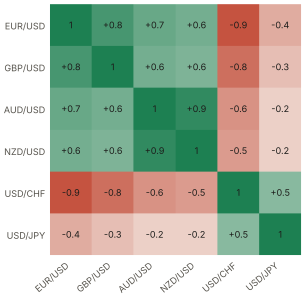
Many pairs share a currency, so they're naturally linked. EUR/USD and GBP/USD both have the dollar as their quote currency, so when the dollar weakens, both tend to rise. EUR/USD and USD/CHF have the dollar on opposite sides, so they tend to move in opposite directions. AUD/USD and NZD/USD are close cousins because their economies are so connected.
Why correlation matters for your risk
Alex sees a buy setup on EUR/USD and another on GBP/USD, and takes both, risking 1 percent on each.
But EUR/USD and GBP/USD often have a correlation of around +0.8. If the dollar suddenly strengthens, both trades are likely to lose at the same time. In practice, Alex has made one bet, "the dollar will weaken," and risked close to 2 percent on it.
A better choice would be to pick the better of the two setups, or to split the 1 percent between them, so the total risk on the single idea stays at 1 percent.
The opposite also matters. If you buy EUR/USD and buy USD/CHF at the same time, the two trades tend to cancel each other out, so you're paying two spreads to do roughly nothing.
Correlations aren't fixed. They change over months and can break down completely during big events. Most platforms and charting sites have correlation tools, or you can simply put two charts side by side and look.
The US Dollar Index
The US Dollar Index (DXY) measures the dollar against a basket of six currencies: the euro, the yen, the pound, the Canadian dollar, the Swedish krona, and the Swiss franc. The euro makes up about 58 percent of the basket, so the DXY moves almost like an upside-down EUR/USD.
Traders use it as a quick check on the dollar's overall strength. If the DXY is falling hard, the dollar is weak across the board, and a buy on EUR/USD or GBP/USD is going with the flow. If you're buying EUR/USD while the DXY is shooting up, you're swimming against the current, which is fine if you're a salmon but not ideal as a trader.
Key terms from this lesson
- Risk-on / risk-off
- market moods of confidence or fear.
- Safe-haven currency
- a currency investors tend to buy in times of fear, such as the USD, JPY, or CHF.
- Commodity currency
- a currency closely linked to the price of a country's major exports, such as the AUD or CAD.
- Correlation
- a measure from −1 to +1 of how closely two things move together.
- US Dollar Index (DXY)
- an index of the US dollar against six major currencies.
Learn this in a 5-minute interactive lesson
Real charts and practice questions. Free, no sign-up needed.
Related guides
Pajama Markets provides education, not financial advice. Trading forex, crypto and leveraged products carries a high risk of losing money. Practise on a demo account first.