Crypto Trading · lesson 12 of 29
The Exchange Screen and Order Types Explained
Learn this in a 5-minute interactive lesson
Real charts and practice questions. Free, no sign-up needed.
A tour of the trading screen
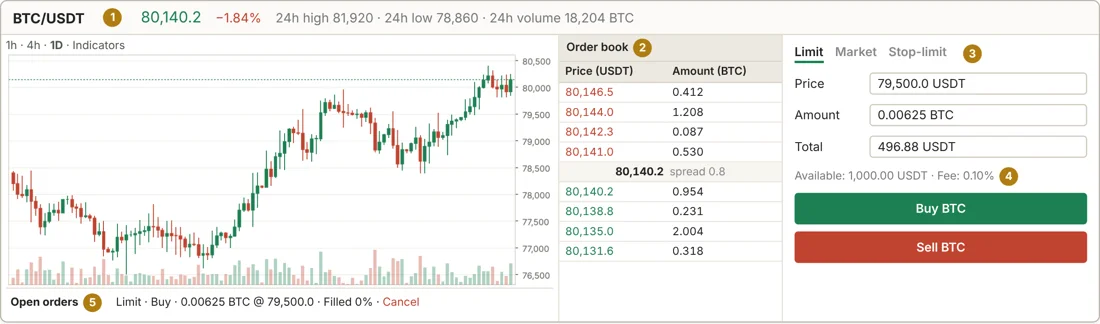
Most exchanges look roughly the same. The pair at the top, such as BTC/USDT, tells you what you're trading: bitcoin, priced in USDT. Just like in forex, the first asset is the one you're buying or selling, and the second is what the price is written in. In ETH/BTC, the price of ether is written in bitcoin, so if it shows 0.0300, one ether costs 0.03 bitcoin.
The order book
The order book is a live list of everyone waiting to trade:
- Asks (red, above) are offers to sell, from the cheapest upwards.
- Bids (green, below) are offers to buy, from the highest downwards.
- The gap between the best ask and the best bid is the spread.
- The amounts at each price show the depth: how much you could buy or sell before the price moves.
For bitcoin on a big exchange, the spread is often less than a dollar and there's plenty of depth. For a small coin, the spread might be 1 percent and the book might be so thin that a $2,000 order moves the price several percent. Before trading anything small, look at the order book. If it looks like a desert, it is one.
Makers and takers
- A taker places an order that fills immediately against an order already in the book, for example a market order. Takers take liquidity.
- A maker places an order that waits in the book, for example a limit buy below the current price. Makers make liquidity.
Exchanges usually charge takers more than makers. A common spot fee is around 0.1 percent, sometimes lower for makers or for people holding the exchange's token. On a $5,000 trade, 0.1 percent is $5 each way. That's not much on one trade, but it adds up fast if you trade often.
Order types
- Market order: buy or sell right now at the best available price. Fast, but you accept whatever the book gives you, which can be bad for big orders or thin coins.
- Limit order: buy or sell only at your price or better. You control the price, but the order might never fill.
- Stop-market order: when the price reaches your stop price, a market order is sent. It's used for stop losses. It fills, but in a fast move it can fill well beyond your stop.
- Stop-limit order: when the price reaches your stop price, a limit order is placed at your limit price. You control the worst price, but in a fast crash the price can jump straight past your limit, leaving your order unfilled and your coins unsold.
- OCO (one cancels the other): a take-profit order and a stop order placed together. When one fills, the other is cancelled automatically.
- Post-only: a limit order that's cancelled if it would fill immediately, so you're always the maker.
Alex owns ETH bought at $2,400 and places a stop-limit to sell: stop price $2,300, limit price $2,290.
On a quiet day, the price drifts down to $2,300, the limit order is placed at $2,290, and it fills. Loss controlled.
On a crash day, the price falls from $2,320 to $2,240 in a few seconds. The stop at $2,300 triggers and places a sell order at $2,290, but the price is already below it. The order sits unfilled while the price keeps falling. Alex still owns the ETH, now at $2,240 and dropping.
A stop-market order would have sold, maybe at $2,260 instead of $2,300, but it would have sold. For stop losses on volatile coins, many traders prefer stop-market orders, or a stop-limit with a much wider gap between the stop and the limit.
Open the BTC/USDT order book on any exchange, then the order book of a small coin ranked outside the top 200. For each, write down the spread and how much you could buy within 1 percent of the current price. Then imagine trying to sell $5,000 of the small coin in a hurry.
Key terms from this lesson
- Trading pair
- two assets quoted against each other, such as BTC/USDT.
- Order book
- the live list of buy and sell orders waiting on an exchange.
- Bid / ask
- the best prices buyers are offering and sellers are asking.
- Depth
- how much can be traded near the current price.
- Maker / taker
- a trader whose order waits in the book, or one whose order fills immediately against it.
- Stop-limit order
- an order that places a limit order once a stop price is reached.
- Stop-market order
- an order that places a market order once a stop price is reached.
- OCO (one cancels the other)
- two linked orders where filling one cancels the other.
Learn this in a 5-minute interactive lesson
Real charts and practice questions. Free, no sign-up needed.
Related guides
Pajama Markets provides education, not financial advice. Trading forex, crypto and leveraged products carries a high risk of losing money. Practise on a demo account first.