Money Foundations · lesson 13 of 28
From Goldsmiths to Banks Explained
Learn this in a 5-minute interactive lesson
Real charts and practice questions. Free, no sign-up needed.
Gold is a pain to carry around
Gold and silver are great at holding value and awkward at almost everything else. Metal is heavy, it attracts thieves, and you have to weigh and test it before any large payment. A merchant walking between towns with a bag of coins was basically a mobile invitation to get robbed.
In seventeenth-century London, merchants found a workaround. In 1640, King Charles I, short of cash, seized the gold merchants had left for safekeeping at the Royal Mint in the Tower of London. He gave most of it back eventually, but the trust never fully returned. Merchants decided that a king's vault wasn't the best place to protect gold from a king, so they started storing it with goldsmiths, who had strong vaults and, crucially, no army. The goldsmith gave each depositor a written receipt saying how much metal was being held for them.
Receipts start doing the work
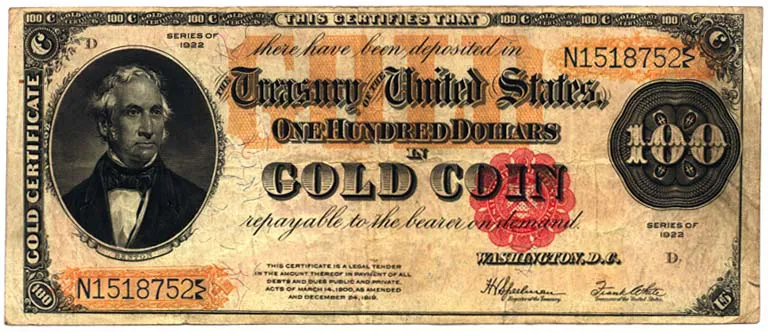
Before long, people started passing the receipts around. A merchant who owed a supplier could just hand over a goldsmith's receipt instead of collecting the gold and hauling it across town. As long as the supplier trusted the goldsmith, the receipt was as good as gold, and a lot lighter. Over time goldsmiths began issuing receipts in round amounts, payable to whoever held them. These were early banknotes.
At first, every receipt was backed one for one by metal in the vault. If a goldsmith held 1,000 ounces of gold, there were receipts for exactly 1,000 ounces out there. That's a full-reserve arrangement, and the receipt is basically a coat-check ticket.
The goldsmiths notice something
Goldsmiths soon noticed that on any given day, only a small share of depositors came to collect their gold. Most were happy to leave it in the vault and keep trading the receipts. So most of the gold just sat there doing nothing, which, if you're running a business, is painful to watch.
So the goldsmiths started lending. Some lent out part of the gold itself. Others wrote extra receipts, as loans, for more gold than they actually had. A goldsmith with 1,000 ounces might have receipts for 3,000 ounces in circulation, betting that no more than a third of the holders would ever come for their metal at the same time. The goldsmith earned interest on the loans and, presumably, moved into a nicer house.
That's fractional-reserve banking. The bank keeps only part of what it owes as ready cash or metal, called the reserve, and lends or invests the rest.
Reading a bank's balance sheet
Banks track their position on a balance sheet, which has two sides. Assets are what the bank owns or is owed. Liabilities are what it owes other people. The difference between the two is the bank's capital (or equity). That belongs to the owners, and it's the cushion that absorbs losses before depositors feel them.
A goldsmith holds 1,000 ounces of gold deposited by customers and has written receipts for exactly that amount. It then makes loans by writing another 2,000 ounces' worth of receipts for borrowers. It also has 100 ounces of its own gold as capital.
| Assets | Liabilities and capital | ||
|---|---|---|---|
| Gold in the vault | 1,100 | Receipts held by depositors | 1,000 |
| Loans to borrowers | 2,000 | Receipts issued to borrowers | 2,000 |
| Capital (owners' stake) | 100 | ||
| Total | 3,100 | Total | 3,100 |
The reserve ratio is 1,100 ÷ 3,000 ≈ 37 percent, so the goldsmith could pay out gold for about 37 percent of its receipts if everyone showed up at once. The loans are worth something, but they can't be turned into gold on the spot. That gap is what Chapter 14 is about.
Scam or trade-off?
You'll sometimes see fractional-reserve banking called a giant scam online. A better way to think about it is as a trade-off. It turns savings that would otherwise sit idle into loans for homes, factories, farms, and businesses, which lets an economy produce more. Most of the world's investment depends on it. The cost is fragility: a bank that's promised more cash on demand than it actually holds can fail if too many people ask for their money at once. That's a known weak spot rather than a con, and, as the next few chapters show, societies have spent about three hundred years trying to reinforce it.
Key terms from this lesson
- Full reserve
- an arrangement in which every claim is backed one for one by cash or metal held.
- Fractional reserve
- an arrangement in which only part of a bank's obligations is held as ready reserves.
- Reserve ratio
- reserves divided by the obligations they support.
- Balance sheet
- a statement of assets, liabilities, and capital at a point in time.
- Asset
- something owned or owed to you.
- Liability
- something you owe to others.
- Capital (equity)
- assets minus liabilities; the owners' stake.
Learn this in a 5-minute interactive lesson
Real charts and practice questions. Free, no sign-up needed.
Related guides
Pajama Markets provides education, not financial advice. Trading forex, crypto and leveraged products carries a high risk of losing money. Practise on a demo account first.