Money Foundations · lesson 15 of 28
Central Banks Explained
Learn this in a 5-minute interactive lesson
Real charts and practice questions. Free, no sign-up needed.
The bank in the middle
A central bank sits in the middle of a country's money and financial system. Commercial banks keep accounts with it, the government banks with it, and it issues the country's currency. What it decides affects the interest rate on every mortgage, credit card, and savings account in the country. Its leaders are famous for talking in a language so cautious it has its own nickname, "Fedspeak," where "we remain attentive to developments" can mean anything from "relax" to "brace yourselves."
How it started
The oldest central bank still running is Sweden's Riksbank, founded in 1668. The Bank of England came next in 1694, set up as a private company to lend the government money for a war against France. A surprising number of famous financial institutions started out as ways to pay for wars. Over the next two centuries the Bank of England gradually took on the job of a central bank, including holding other banks' reserves.
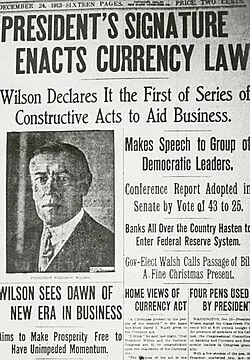
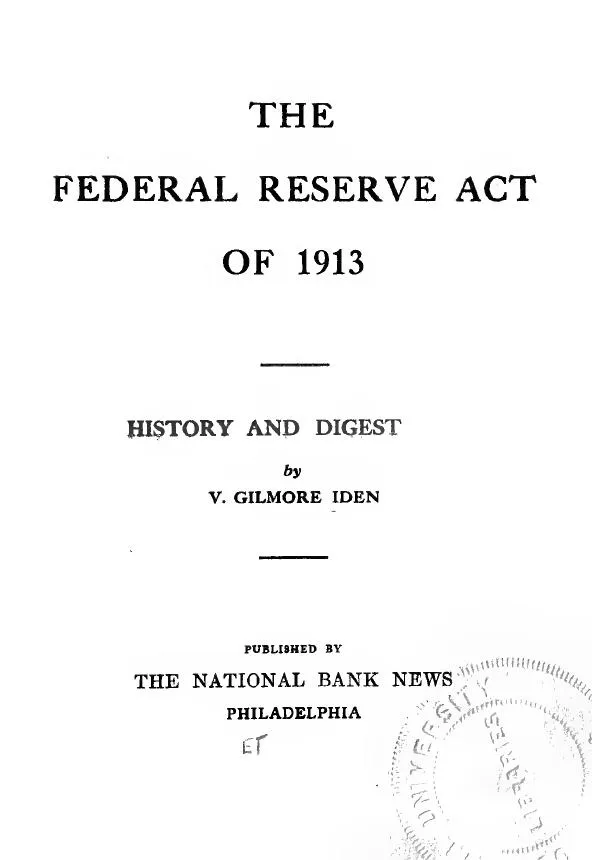
The United States held out against having a central bank for most of its history, and its banking system had panic after panic as a result. In a bad crisis in 1907, the financier J. P. Morgan famously locked a group of bankers in his library overnight until they agreed to put up emergency money. It worked, but Congress decided that relying on one rich man's library wasn't a long-term plan. President Woodrow Wilson signed the Federal Reserve Act on 23 December 1913.
Central banks around the world appeared at different times. The Bank of Japan was founded in 1882, the Bank of Canada in 1934, the Reserve Bank of India in 1935, and the People's Bank of China in 1948. The European Central Bank is a relative newcomer: it was set up in 1998 and now sets interest rates for the twenty-one countries that use the euro, which makes it one of the most powerful institutions in the world whose boss most Europeans couldn't name.
What a central bank actually does
It varies by country, but most central banks:
- 1.Issue the national currency, the notes and coins in your pocket.
- 2.Act as the bankers' bank, holding reserve accounts for commercial banks and settling payments between them.
- 3.Act as lender of last resort, providing emergency cash to banks during a crisis.
- 4.Run monetary policy, mainly by setting a short-term interest rate to keep inflation low and stable.
- 5.Act as the government's bank, managing its accounts and often its borrowing.
- 6.Hold the country's foreign-exchange reserves, which they can use to influence the exchange rate.
- 7.Supervise banks, in many countries, to make sure they hold enough capital and cash.
The lender of last resort
In 1873 the British journalist Walter Bagehot, editor of The Economist, set out the rule central banks still follow in a crisis. In a panic, he wrote in his book Lombard Street, the central bank should lend freely, at a high rate of interest, against good collateral.
Each part has a job. Lending freely calms the panic by showing everyone the cash is there. Charging a high rate stops banks leaning on the central bank in normal times. Insisting on good collateral means the central bank helps banks that are stuck but healthy, not ones that are actually broke. It's held up remarkably well for advice from a journalist on deadline more than 150 years ago.
Why central banks are kept at arm's length
A central bank can stop a panic. It can also make it very easy for a government to spend more than it collects in taxes, by buying government debt with newly created money. Chapter 10 showed what happens when that gets abused. To guard against the temptation, many countries have made their central banks independent, meaning they set interest rates without taking orders from the government of the day, within a goal set by law. The Bank of England got this independence in 1997, and the European Central Bank was designed to be independent from the start. The idea is simple: keep the money-printing decisions away from people who have elections to win. Politicians generally agree with this, except on days when interest rates go up.
Key terms from this lesson
- Central bank
- the institution that issues a country's currency, manages its monetary policy, and stands behind its banking system.
- Lender of last resort
- a central bank's role in lending to banks when no one else will.
- Bagehot's rule
- in a panic, lend freely, at a high rate, against good collateral.
- Collateral
- an asset pledged to secure a loan.
- Central bank independence
- legal freedom for the central bank to set policy without political direction.
Learn this in a 5-minute interactive lesson
Real charts and practice questions. Free, no sign-up needed.
Related guides
Pajama Markets provides education, not financial advice. Trading forex, crypto and leveraged products carries a high risk of losing money. Practise on a demo account first.