Money Foundations · lesson 20 of 28
1971: The End of Gold Convertibility Explained
Learn this in a 5-minute interactive lesson
Real charts and practice questions. Free, no sign-up needed.
A flaw built into the design
As world trade boomed after 1945, countries needed more and more dollars to pay for imports and hold as reserves. The only way the rest of the world could get more dollars was for the United States to spend, lend, or invest more abroad than it took in, sending dollars out into the world.
In 1960 the Belgian-American economist Robert Triffin spotted the catch. The more dollars built up abroad, the less likely it was that the United States could actually swap them all for gold at $35. If the US stopped supplying dollars, world trade would run short of reserves. If it kept supplying them, people would stop believing the gold promise. Something had to give either way. This became known as the Triffin dilemma: the system relied on the United States doing the exact thing that would eventually break it. It's a bit like a restaurant that can only stay open by giving away more and more free meals.
Cracks in the 1960s
During the 1960s, US spending on the Vietnam War and on big domestic programmes went up, and so did American inflation. Foreign holders started to doubt that a dollar would always be worth one thirty-fifth of an ounce of gold, and some governments did the obvious thing and asked for the gold. The best-known was France under President Charles de Gaulle, who openly criticised the dollar's special status and converted large amounts of dollars into gold, reportedly sending a French navy ship to help bring some of it home. US gold reserves, around 20,000 tonnes in the late 1950s, fell to about 9,000 tonnes by 1971, while the dollars held by foreign governments grew far beyond the gold available to redeem them. The numbers just didn't add up anymore.
Sunday, 15 August 1971
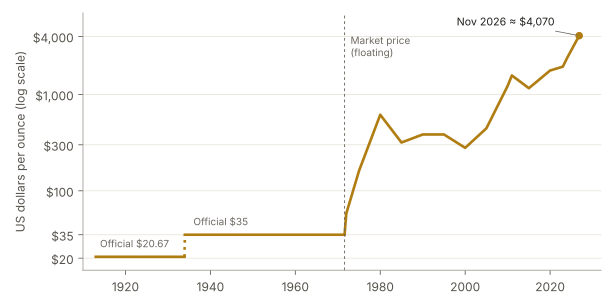
On the evening of Sunday 15 August 1971, President Richard Nixon interrupted one of the most popular TV shows in America to announce that the United States would "suspend temporarily the convertibility of the dollar into gold." Foreign central banks could no longer swap their dollars for American gold. The same speech announced a temporary freeze on wages and prices and a 10 percent tax on imports, and the whole package became known as the Nixon shock.
The suspension was described as temporary. More than fifty years later, it's still in place.
From fixed to floating
Governments tried to save some version of fixed exchange rates. In December 1971 the Smithsonian Agreement devalued the dollar to $38 an ounce and set new exchange rates; Nixon called it "the most significant monetary agreement in the history of the world." It lasted about fifteen months. In February 1973 the dollar was devalued again, to $42.22. By March 1973 the major currencies had given up defending their pegs and started to float, meaning their exchange rates were set by supply and demand in the market, as most major currencies still are today. The modern foreign-exchange market, the one forex traders study, was born in those few months, and it hasn't stopped moving since.
A default means failing to make a promised payment on a debt. In 1971 the United States didn't default. People holding US Treasury bonds kept getting their interest and their money back in full, in dollars. What ended was a different promise: swapping dollars for gold at a fixed price for foreign governments. Calling 1971 a default mixes up those two commitments, and now you'll spot it whenever someone does.
Oil and the dollar
In October 1973, Arab members of OPEC put an oil embargo on the United States and several other countries over their support for Israel in the Yom Kippur War, and the price of oil roughly quadrupled within months. Queues at petrol stations stretched for blocks, and some countries banned driving on Sundays. In 1974 the United States and Saudi Arabia agreed a set of economic and security arrangements. Saudi Arabia kept pricing its oil in dollars and put a large share of its oil earnings into US government securities, and the United States deepened its commitment to Saudi security.
People usually sum this up with the word petrodollar. The mechanism matters more than the label. When the world's most important commodity is priced in dollars, every country that imports oil has to earn, borrow, or hold dollars to pay for it. That creates steady demand for the dollar even without any link to gold. It's one reason, though not the only one, that the dollar stayed at the centre of the world economy after 1971. Chapter 24 covers the others.
The 1970s and the hangover
With no gold anchor and oil shocks pushing costs up, inflation in the United States and many other countries hit double digits during the 1970s, peaking at 13.5 percent in the US in 1980. The UK saw inflation above 20 percent in the mid-1970s. The US finally got it under control when the Federal Reserve, led by Paul Volcker, raised interest rates to around 20 percent in 1980–81, which caused a deep recession. Volcker became so unpopular that farmers drove tractors to the Federal Reserve building in Washington to protest. But inflation came down and stayed down. Central banks still remember the lesson: once people expect high inflation, getting rid of it is painful, and a central bank has to be willing to cause that pain.
Key terms from this lesson
- Triffin dilemma
- the conflict between supplying the world with reserve currency and maintaining confidence in that currency's convertibility.
- Nixon shock
- the US announcement of 15 August 1971 suspending dollar–gold convertibility.
- Smithsonian Agreement
- the December 1971 attempt to restore fixed exchange rates at new levels.
- Floating exchange rate
- an exchange rate set by supply and demand in the market.
- Default
- failure to make a promised payment on a debt.
- Petrodollar
- the arrangement under which oil is priced in dollars, supporting international demand for the currency.
Learn this in a 5-minute interactive lesson
Real charts and practice questions. Free, no sign-up needed.
Related guides
Pajama Markets provides education, not financial advice. Trading forex, crypto and leveraged products carries a high risk of losing money. Practise on a demo account first.