Forex Trading · lesson 31 of 33
Trading Psychology Explained
Learn this in a 5-minute interactive lesson
Real charts and practice questions. Free, no sign-up needed.
Why the plan is easy and the trading is hard
Writing "I'll risk 1 percent and never move my stop" takes ten seconds. Doing it while a trade is 30 pips against you and your stomach is doing backflips is a completely different thing. Your brain wasn't built for trading. It was built for not getting eaten, and it treats losing money a lot like being chased by something with teeth. Psychology is about understanding that, and building rules that protect you from yourself.
The emotional cycle
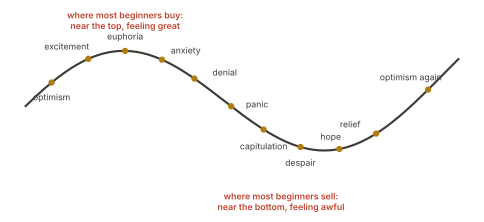
Most beginners go round this loop at least once. It starts with optimism and excitement after a couple of wins. Near the top comes euphoria, the "I'm a genius" moment, which is often when people take their biggest trade. Then the market turns. Anxiety becomes denial ("it'll come back"), then panic, and finally capitulation ("I'm out, this is rigged"), often right near the bottom. If you notice yourself feeling euphoric or desperate, treat that feeling as information: it's a sign to make your next trade smaller, not bigger.
The usual traps
Fear. Fear makes you skip good setups after a few losses, or close winning trades too early to "lock something in." The fix is to make losses smaller until they stop being scary. If 1 percent feels terrifying, trade 0.5 percent. And set your take profit in advance, so you don't have to decide in the moment.
Greed. Greed makes you move your target further away, add to winning trades without a plan, or skip the stop loss because "this one's a sure thing." The fix is pre-set orders: once your stop and target are in, walk away from the screen.
FOMO (fear of missing out). You see a big move happening and jump in late, without a setup, because everyone else seems to be making money. The fix is remembering that the market opens again tomorrow, and every day after that. Missing a move costs you nothing. Chasing one often costs you a lot.
Revenge trading. After a loss, you feel the urge to "win it back" straight away with a bigger trade. This is how one bad trade turns into a bad day. The fix is a hard rule: after two losses in a day, you stop. After any loss that makes you angry, you close the platform and do something else for at least an hour.
Overconfidence. After a winning streak, you start believing you've cracked it, and you take bigger risks or loosen your rules. Winning streaks are partly luck, just like losing streaks. Keep your risk the same after wins as after losses.
Hope. Hope is lovely in real life and terrible in trading. Hope is what makes people move their stop loss further away, or remove it, because they're sure the price will come back. Price doesn't know you're in a trade, and it doesn't care.
Boredom. Good setups don't appear every hour. Boredom makes people trade just to feel like they're doing something. If there's no setup, the correct trade is no trade.
Think in sets of trades
Any single trade is close to a coin toss, even with a good strategy. What makes money is a small edge repeated over many trades. So stop judging each trade on its own. Judge yourself on sets of 20 trades instead. In a set of 20, a strategy that wins 40 percent of the time might win 5 or 12, just by chance. Neither tells you much. What matters is whether you followed your rules on all 20.
This one shift takes away a lot of the fear. A loss stops being a disaster and becomes one of the expected losses in the set, like a goalkeeper conceding a goal. Even the best goalkeepers concede. They don't quit football afterwards.
Practical habits
- Pre-write every trade using the three sentences from Chapter 23, before you click.
- Use alerts instead of watching charts all day. The less you stare, the fewer impulsive trades you'll take.
- Set your stop and target when you enter, then leave them alone.
- Keep risk small enough that a loss doesn't affect your mood for the rest of the day.
- Log your emotions in your journal, so you can see which feelings come before your worst trades.
- Look after the basics. Sleep, food, exercise, and time away from screens all make you a better decision-maker. Trading tired at 2 a.m. is a reliable way to make decisions you'll regret at 9 a.m.
You'll see this all over social media, sometimes as 80 percent, sometimes as 95. Psychology matters a lot, but it can't rescue a strategy with no edge. Perfect discipline applied to random trades just loses money calmly. You need both: a tested strategy with positive expectancy, and the discipline to follow it.
When it stops being trading
Trading with leverage can feel a lot like gambling, and for some people it slides into it. Be honest with yourself if you notice any of these:
- trading with money meant for rent, school fees, bills, or food;
- borrowing money, or using credit cards, to trade or to "win back" losses;
- hiding your trading or your losses from people close to you;
- feeling unable to stop, even after you've decided to;
- needing bigger and bigger trades to feel anything.
If any of these sound familiar, stop trading, tell someone you trust, and consider contacting a gambling support service in your country. There's no shame in it. Plenty of people have been there, and getting help early is a lot easier than getting help late.
Kevin lost one trade, felt cheated, and doubled his size to win it back. He lost again, doubled again, and by the end of the evening had taken eleven trades and lost a third of his account. None of the trades had a setup. The only thing they had in common was that Kevin was angry. If he'd had a rule saying "two losses, then stop," the day would have cost him 2 percent.
Key terms from this lesson
- FOMO (fear of missing out)
- the urge to jump into a move late because others seem to be profiting.
- Revenge trading
- trading impulsively to win back a loss.
- Overconfidence
- taking more risk after a winning streak because you believe you can't lose.
- Tilt
- a state of emotional frustration that leads to poor decisions.
- Edge
- a strategy's small statistical advantage over many trades.
Learn this in a 5-minute interactive lesson
Real charts and practice questions. Free, no sign-up needed.
Related guides
Pajama Markets provides education, not financial advice. Trading forex, crypto and leveraged products carries a high risk of losing money. Practise on a demo account first.