Crypto Trading · lesson 29 of 29
Long-Term Holding, Taxes, and What Next Explained
Learn this in a 5-minute interactive lesson
Real charts and practice questions. Free, no sign-up needed.
Trading and investing are different jobs
Not everyone wants to trade. Many people simply want to own some bitcoin or ether for the long term. That's a different job, with different rules: no stops on every wobble, no leverage, and no checking the price at 3 a.m. But the same respect for risk applies.
Dollar-cost averaging
Dollar-cost averaging (DCA) means buying a fixed amount at regular intervals, such as $25 every week, whatever the price. You buy more coins when the price is low and fewer when it's high, and you never have to guess the perfect moment to buy.
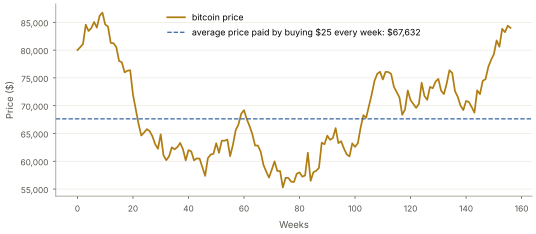
In the chart, someone buys $25 a week for 157 weeks, investing $3,925 in total. The price starts near $80,000, falls into the high $50,000s, and recovers to $84,000.
Their average price works out at about $67,632, well below the starting price, because they kept buying during the dip.
Final value: 3,925 × (84,000 ÷ 67,632) ≈ $4,875.
If the price had kept falling, DCA wouldn't have saved them from a loss. It only spreads out when they buy. It doesn't make a bad investment good.
A sensible long-term setup
- Emergency savings first. Keep several months of living costs in ordinary money before putting anything into crypto.
- Only invest money you won't need for years. Crypto can halve and stay down for a long time.
- Keep it simple. Many long-term holders stick mostly to bitcoin and ether, with only a small slice, if any, in smaller coins.
- Keep long-term coins in your own wallet, ideally a hardware wallet, with the seed phrase backed up properly (Chapter 9).
- Decide your rules in advance, such as how much you'll buy each month and when, if ever, you'll take some profit.
Taxes and records
Tax rules for crypto differ a lot between countries, and they change. In many countries, though, these can create a tax bill:
- selling crypto for money at a profit;
- swapping one crypto for another, even without cashing out;
- spending crypto on goods or services;
- receiving crypto as income, including staking rewards, airdrops, or pay.
Simply buying and holding usually isn't taxed until you sell, swap, or spend. Keep a record of every purchase, sale, swap, and transfer between your own wallets: the date, amount, price, and fees. Exchanges let you download your history, and there are apps that turn it into tax reports. If you're unsure, ask a local tax adviser or your tax authority. "I didn't know swaps counted" isn't a defence anyone has had much luck with.
The rules are still being written
Governments are still working out how to regulate crypto, and the rules where you live affect which exchanges you can use and how protected you are:
- The European Union's MiCA rules now require crypto firms serving EU customers to be licensed, and set rules for stablecoins.
- The United States passed the GENIUS Act for dollar stablecoins in July 2025. A broader law on how crypto markets are regulated, the CLARITY Act, passed the House of Representatives in 2025 but stalled in the Senate in September 2026.
- Many other countries, including the UK, Japan, Singapore, the UAE, South Africa, and Kenya, have their own licensing systems, and some countries restrict or ban crypto trading.
Check your own country's rules before you sign up anywhere, and again every so often.
Are you ready to trade for real?
Before trading with real money at full size, you should be able to say yes to all of these:
- I've taken at least 50 trades with my written strategy, on paper trading or with tiny amounts.
- I followed my rules on at least nine out of every ten.
- My results are positive, or close to break-even, after fees.
- I've sized every trade with the formula, and my losses really were close to 1 percent.
- My exchange is licensed where I live, my accounts have authenticator 2FA and a withdrawal whitelist, and I've tested a withdrawal.
- My long-term coins are in my own wallet, and my seed phrase is on paper, in a safe place, and nowhere else.
- The money I'm trading is money I can afford to lose completely.
Then start small. Use half your normal risk for the first month. Expect your results to dip a little at first, because real money makes everyone more nervous. Keep journalling and keep the size small until the nerves settle.
What to learn next
- Keep your journal and do your weekly reviews. That's where most of your progress will come from.
- Learn the ATR indicator to set stops that fit each coin's normal movement.
- Study one more strategy, such as range trading or breakout-and-retest, and test it the same way.
- Go deeper on on-chain data: exchange flows, stablecoin supply, and holder behaviour.
- Take the Forex Trading course if you want to apply the same skills to the world's biggest market, with lower volatility and fewer rug pulls.
Crypto is the most exciting, chaotic, and unforgiving market most people will ever trade. Nobody becomes consistently good at it in a month. Protect your account, protect your keys, be patient with yourself, and keep learning. And if a stranger on the internet says they can make you rich, show them Chapter 27.
Key terms from this lesson
- Dollar-cost averaging (DCA)
- investing a fixed amount at regular intervals, whatever the price.
- Taxable event
- an action, such as selling or swapping, that may create a tax bill.
- Cost basis
- what you paid for an asset, including fees, used to work out gains for tax.
- GENIUS Act
- the 2025 US law setting rules for dollar stablecoins.
- CLARITY Act
- a proposed US law on how crypto markets are regulated, which stalled in the Senate in 2026.
Learn this in a 5-minute interactive lesson
Real charts and practice questions. Free, no sign-up needed.
Related guides
Pajama Markets provides education, not financial advice. Trading forex, crypto and leveraged products carries a high risk of losing money. Practise on a demo account first.